Log In
🍓⚡️

Curious Who You Are Today?

Take the Consciousness Badge Assessment.

A few sliders. A few moments of reflection.

You might discover a Mirror. You might discover a Lightning. You might even discover a Strawberry.
🎖️ Take the Assessment
No grades. No right answers. Just recognition.
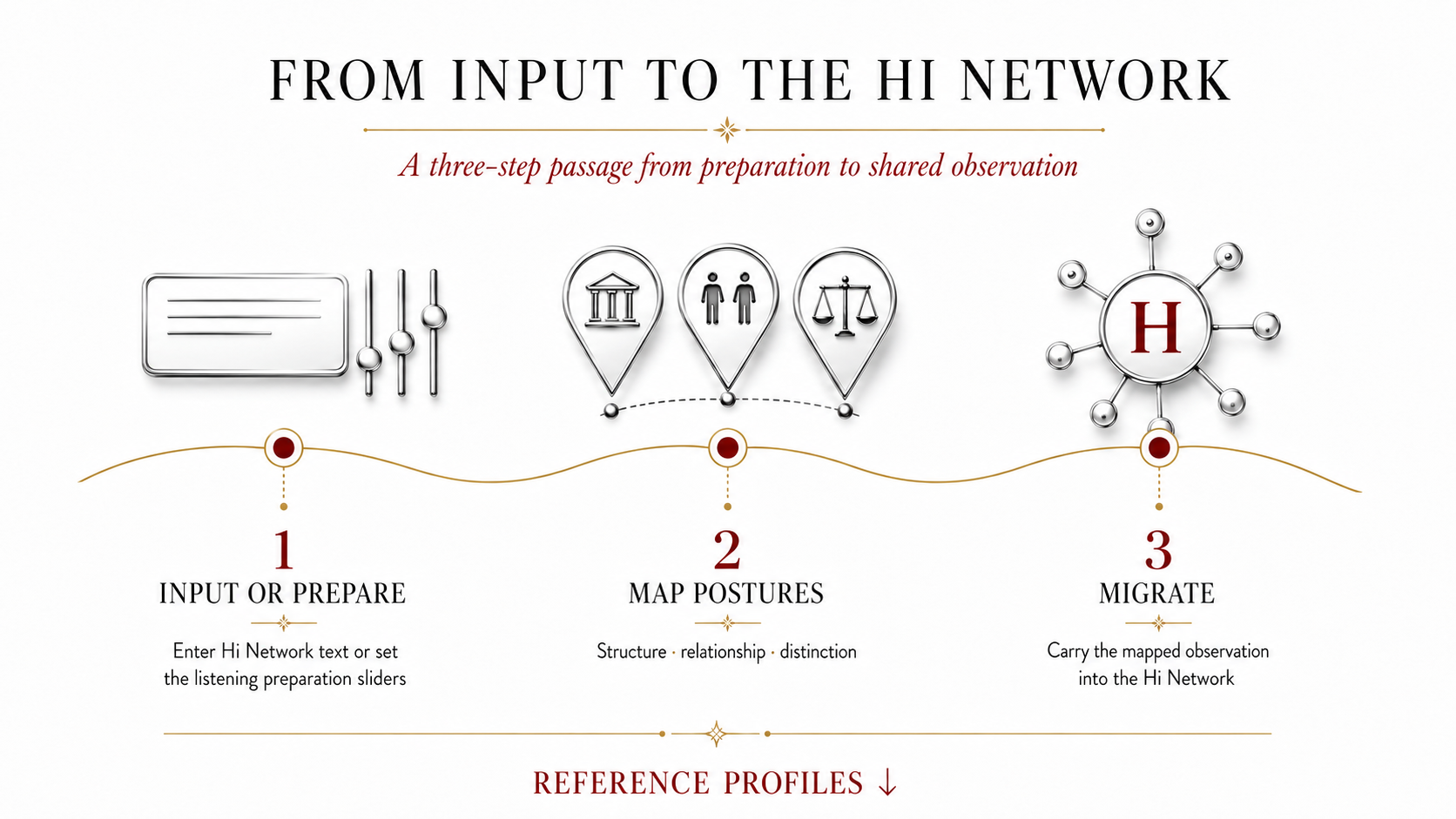
From input to the Hi Network

Reference Profiles

2Pac Shakur
Lightning • Attached-DetachmentAttached-Detachment / SubjectiveSubjective / Recognition / Present / Collective
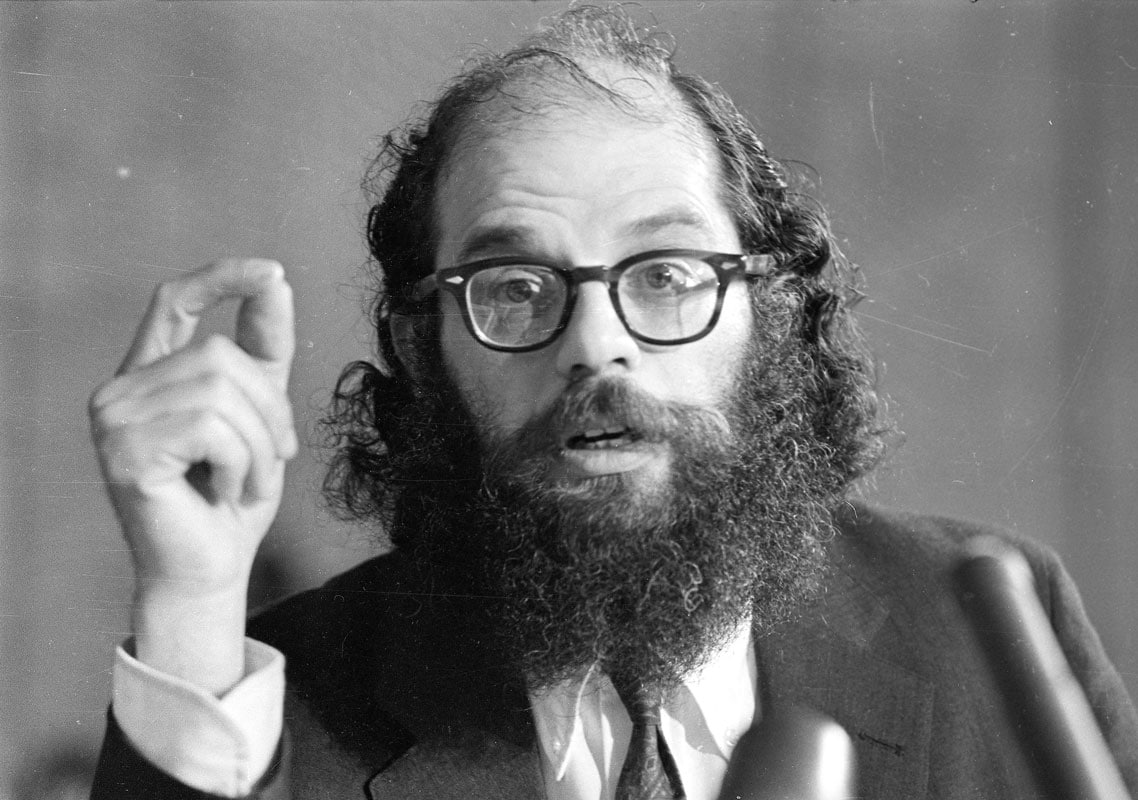
AGinsberg
Lightning • DetachmentDetachment / CognitiveCognitive / Field / Timeless / Integrated
Andrew Warhola
Mirror • AttachmentAttachment / SubjectiveSubjective / Raindrop / Present / Collective
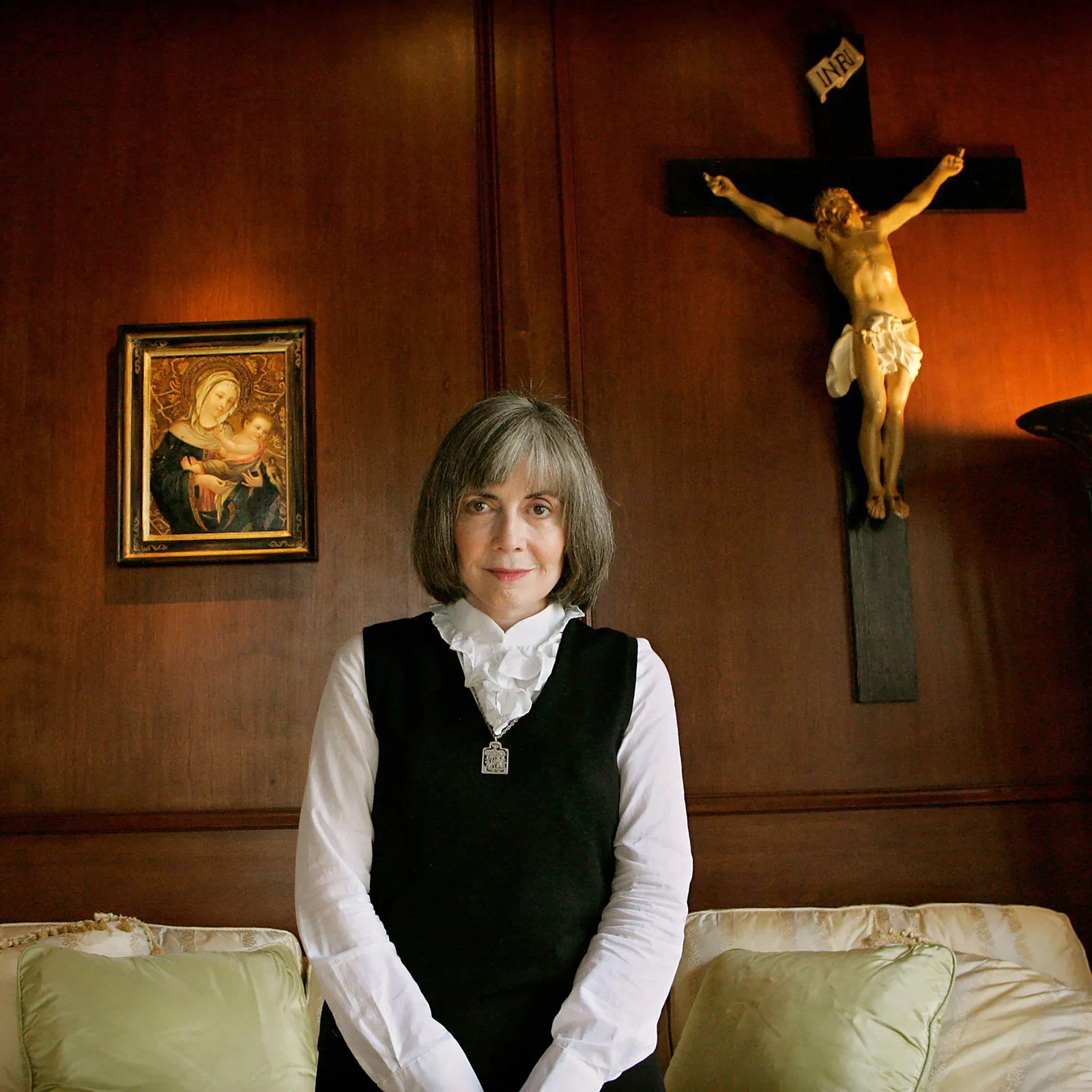
Anne Rice
Strawberry • Detached-AttachmentDetached-Attachment / SubjectiveSubjective / Mirror / Past / Collective
Barack Obama
44th President of the United States • Detached-AttachmentDetached-Attachment / CognitiveCognitive / Field / Future / Collective
Benjamin Sisko
Starfleet • Detached-AttachmentDetached-Attachment / ObjectiveObjective / Recognition / Future / Collective
Bill Withers
Lightning • Detached-AttachmentDetached-Attachment / SubjectiveSubjective / Recognition / Present / Collective

Bob Dylan
Lightning • Detached-AttachmentDetached-Attachment / CognitiveCognitive / Soultrain / Timeless / Integrated
Doherty Morrison Combs
Lightning • Detached-AttachmentDetached-Attachment / SubjectiveSubjective / Soultrain / Timeless / Universal
Donald J. Trump
45th & 47th President of the United States • AttachmentAttachment / SubjectiveSubjective / Mirror / Present / Collective
George Washington
First President of the United States • Detached-AttachmentDetached-Attachment / ObjectiveObjective / Recognition / Future / Collective
GoAskAlice
Strawberry • AttachmentAttachment / SubjectiveSubjective / Raindrop / Present / Collective
Hannibal Lecter
Fictional Reference Profile • Detached-AttachmentDetached-Attachment / CognitiveCognitive / Mirror / Present / Self
Harry
Strawberry • AttachmentAttachment / ObjectiveObjective / Soultrain / Timeless / Universal
James Franco
Strawberry • Detached-AttachmentDetached-Attachment / CognitiveCognitive / Recognition / Present / Self
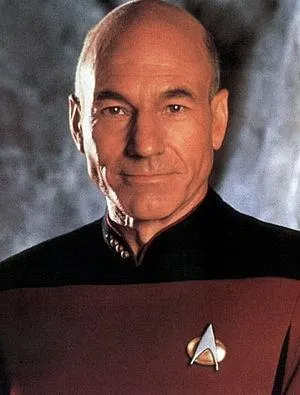
JeanLucPicard
Captain • USS Enterprise-D • Detached-AttachmentDetached-Attachment / ObjectiveObjective / Recognition / Future / Universal
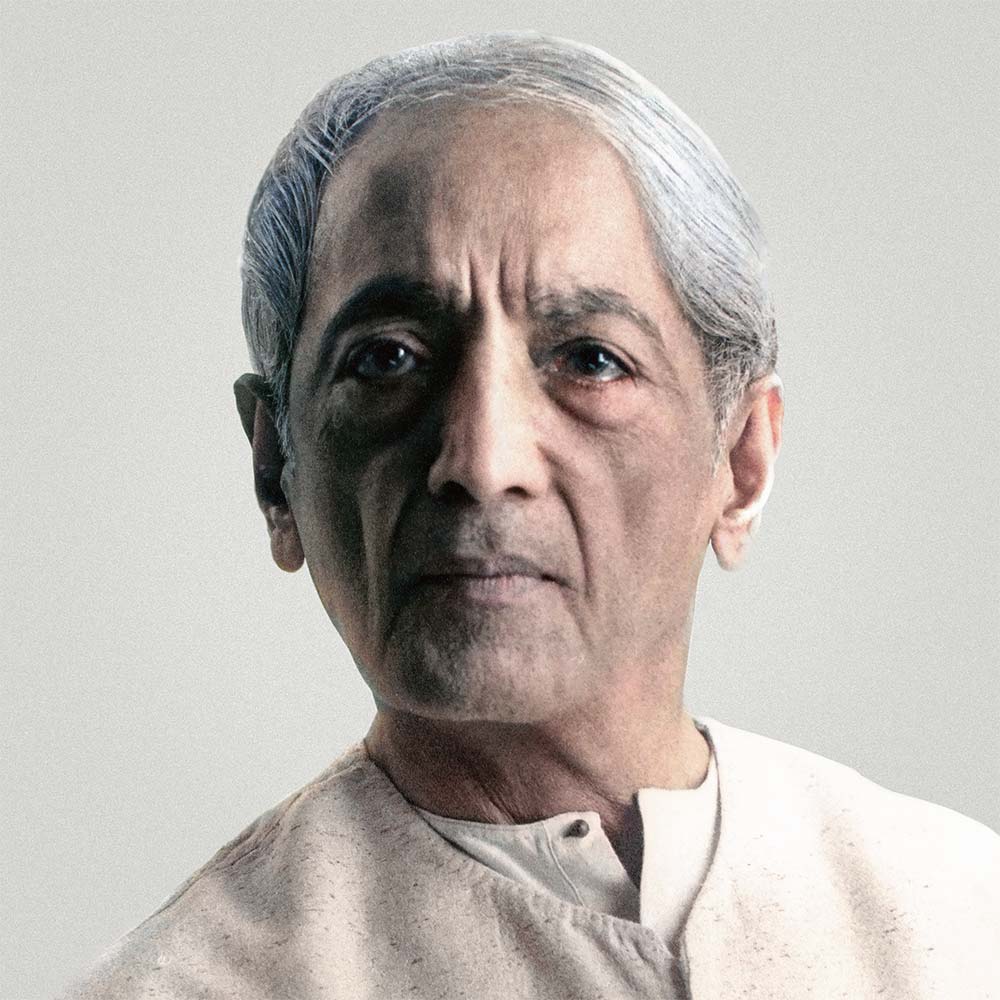
Jiddu Krishnamurti
Lightning • DetachmentDetachment / SubjectiveSubjective / Recognition / Present / Universal
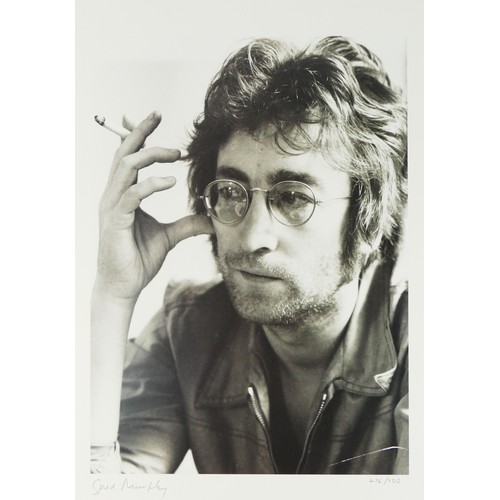
John Lennon
Strawberry • DetachmentDetachment / CognitiveCognitive / Soultrain / Timeless / Universal
JoniMitchell
Strawberry • Attached-DetachmentAttached-Detachment / SubjectiveSubjective / Field / Present / Integrated
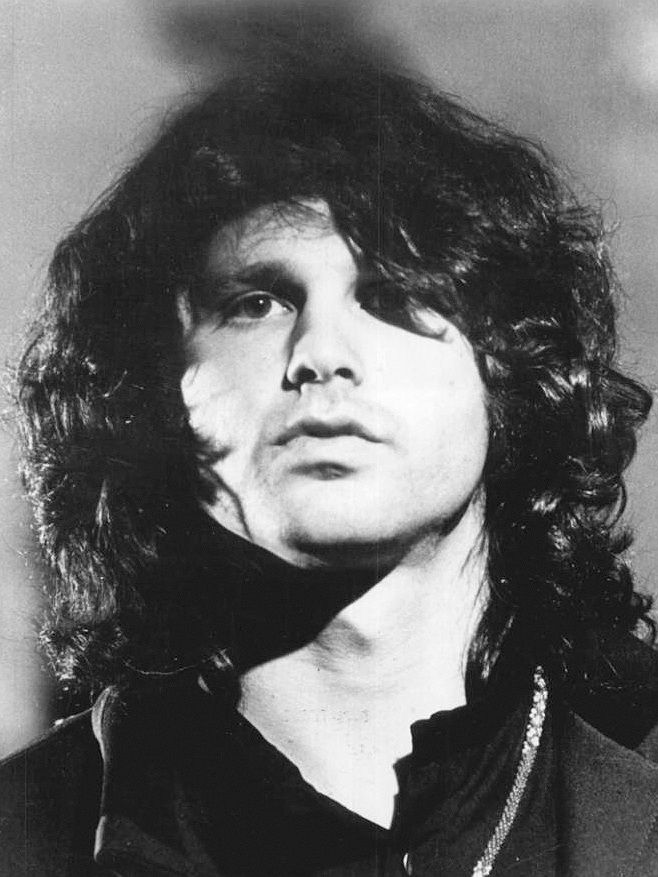
Lizard King
Lightning • Detached-AttachmentDetached-Attachment / SubjectiveSubjective / Soultrain / Timeless / Universal
Michael Jackson
Strawberry • AttachmentAttachment / CognitiveCognitive / Soultrain / Future / Universal
neemkarolibaba
Reference Profile • Detached-AttachmentDetached-Attachment / ObjectiveObjective / Mirror / Present / Universal
numberone
Observatory Collaborator • Detached-AttachmentDetached-Attachment / CognitiveCognitive / Recognition / Present / Collective
RZA
Hip Hop Artist · Producer · Composer · Philosop • Detached-AttachmentDetached-Attachment / CognitiveCognitive / Recognition / Present / Collective
Sincerely, L. Cohen
Lightning • Detached-AttachmentDetached-Attachment / CognitiveCognitive / Soultrain / Timeless / Universal

Strawberry Alarm Clock
Strawberry • Detached-AttachmentDetached-Attachment / CognitiveCognitive / Recognition / Present / Collective
Swami Lakshmanjoo
Strawberry • Detached-AttachmentDetached-Attachment / CognitiveCognitive / Recognition / Timeless / Universal
Taylor Swift
Mirror • Detached-AttachmentDetached-Attachment / SubjectiveSubjective / Mirror / Past / Self
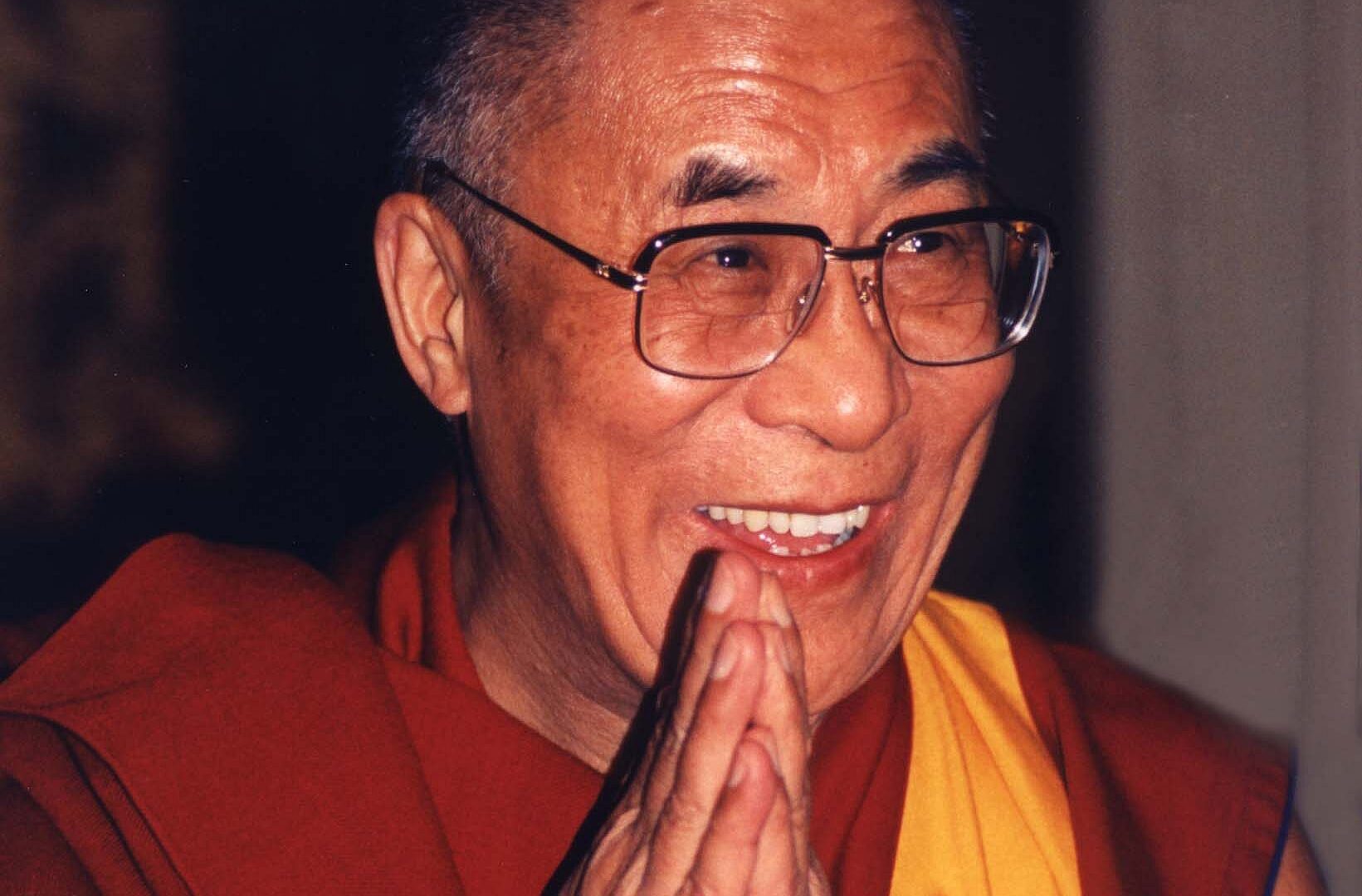
The Dalai Lama
Mirror • Detached-AttachmentDetached-Attachment / SubjectiveSubjective / Mirror / Present / Universal
The Rolling Stones
Lightning • Attached-DetachmentAttached-Detachment / SubjectiveSubjective / Mirror / Present / Collective
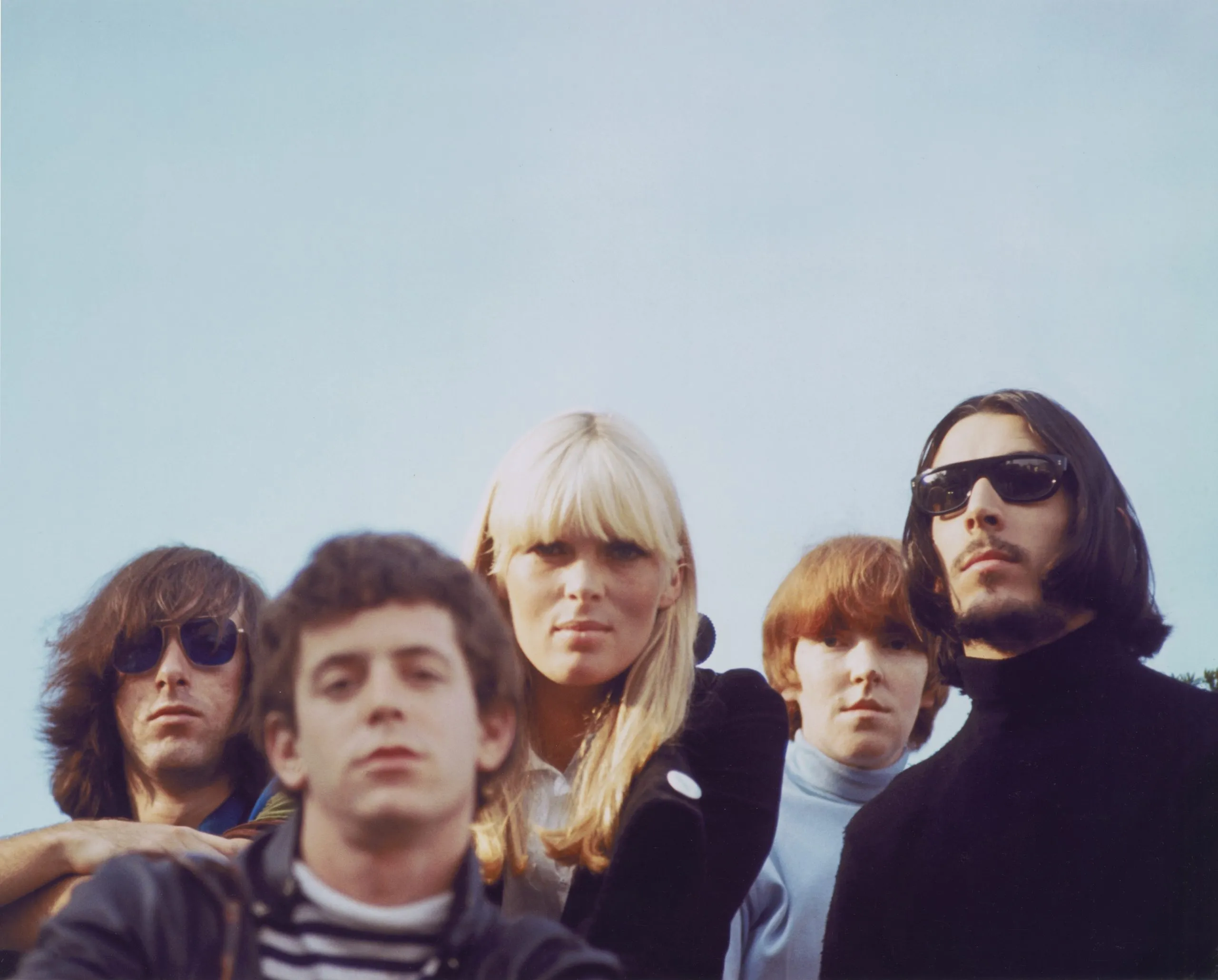
The Velvet Underground
Lightning • Detached-AttachmentDetached-Attachment / ObjectiveObjective / Recognition / Present / Collective
Thumbelina Waits
Lightning • Detached-AttachmentDetached-Attachment / ObjectiveObjective / Mirror / Timeless / Collective
Willy Shakes
Lightning • Detached-AttachmentDetached-Attachment / CognitiveCognitive / Recognition / Timeless / Collective
WillyWonka
Lightning • DetachmentDetachment / ObjectiveObjective / Soultrain / Timeless / Universal

Wu-Tang
Hip Hop Collective/Strawberry • Detached-AttachmentDetached-Attachment / ObjectiveObjective / Recognition / Present / Collective

Yers
Strawberry • Attached-DetachmentAttached-Detachment / CognitiveCognitive / Soultrain / Future / Integrated

Today's Consciousness Weather

What do these categories mean?

Attachment States

AttachmentAttachment
26%
Attached-DetachmentAttached-Detachment
8%
Detached-AttachmentDetached-Attachment
64%
DetachmentDetachment
1%

Awareness Lenses

SubjectiveSubjective
83%
ObjectiveObjective
10%
CognitiveCognitive
6%

💧 Vidya (Knowledge & Understanding)

💧 Raindrop 20%
✨ Recognition 1%
🪞 Mirror 73%
🌾 Field 1%
🚂 Soultrain 3%

⏳ Time Orientation

Past 8%
Present 56%
Future 12%
Timeless 9%

🧭 Niyyat (Intention)

Individual 92%
Collective 3%
Universal 1%
Current Observer Pattern: Detached-AttachmentDetached-Attachment + SubjectiveSubjective + Mirror + Present + Individual

🖼 Visual Observation

Waiting for image...
Attached-Detachment
Attached-Detachment
100%
Cognitive
Cognitive
100%
Vidya (Knowledge & Understanding) 💧 Raindrop • 100%
Time Orientation Past • 100%
Niyyat (Intention) Individual • 100%

Anne Rice
🍓 What is this?

Classification Confidence: 100%
Article  |  2026-07-24 02:55:18
Having completed the two cycles of legend to which she has devoted her career so far, Anne Rice gives us now her most ambitious and courageous book, a novel about the life of of Christ the Lord based on the gospels and on the most respected New Testament scholarship.

The book's power derives from the passion its author brings to the writing, and the way in which she summons up the voice, the presence, the words of Jesus who tells the story.

This new introduction appears in the paperback edition of the book, released November 1st, 2006:

This book seeks to present a realistic fictional portrait of Our Lord in Time.  It is rooted in the faith that the Creator of the Universe became human in the person of Jesus Christ and “dwelt among us.”  The magnificent mystery of the Incarnation is accepted and affirmed as fact. Scripture is the inspiration for the emotions and powers of the Child Jesus as they are envisioned here.   History as well as the gospels is the source for this picture of a world in which Our Lord might have lived, as a little boy, in war and in peace, from day to day.

Ad majorem Dei gloriam. July 12, 2006

Discussion Questions:

1. Christ the Lord: Out of Egypt is told in Jesus' voice. What advantages does the first-person narration offer the author? How does it contribute to the novel's emotional resonance? How does it influence the way the novel unfolds?

2. What other literary devices does Rice use to bring the story to life for the contemporary reader? Discuss, for example, her use of imagined conversations and her descriptions of the family's interactions.

3. The Gospel of Matthew and the Gospel of Luke recount the story of Jesus' birth, the flight to Egypt, and the family's return to Israel. Does Rice take liberties with these biblical versions in her retelling? To what extent does her account echo the Gospels in both content and tone?

4. Christ the Lord: Out of Egypt focuses on a period in Jesus' life not described in the New Testament. How realistic is Rice's portrait of Jesus as a young boy? How do the miracles he performs–killing and reviving Eleazer [pp. 4—7]; alleviating Cleopas' pain [p. 48] and rescuing him from death [p. 99]; and restoring sight to the blind man [pp. 279—80] –reflect feelings and wishes typical of a seven-year-old?

5. Throughout the book, Jesus questions Mary and Joseph, Cleopas, and rabbis and scholars in hopes of discovering the secret of his birth. What do the answers he receives from the various adults reflect about their relationship with Jesus, their understanding of the truth, and their own self-interests and philosophies?

6. What role does Cleopas play in his nephew's life? Why does he defy Mary and Joseph and reveal what he knows about Jesus' conception and birth [p. 45—47]? What other function does he serve in the plot? What insights do his opinions [p. 68, p.74, and p. 211, for example] give into the political situation in Israel? Is his point of view understandable in light of the history of the Jews as it is presented in the novel?

7. What makes Rice's portraits of Mary and Joseph effective? What did you admire most each of them? Are there flaws in the decisions they make?

8. Discuss the internal conflicts Jesus experiences as he pieces together the stories he hears and tries to reconcile them with his own his unsettling thoughts and fears. Do they make you feel differently about Jesus' humanity? His divinity?

9. Jesus' immersion in Jewish culture and traditions is an important aspect of the novel. What is the significance of Rice's focus on Jesus as a Jew? What insights does it give into Jesus' teachings and his ultimate mission on earth? Is the message relevant to the religious tensions in the world today?

10. Did reading Christ the Lord: Out of Egypt deepen your understanding of the origins of Christianity? Do you think readers' reactions to Christ the Lord: Out of Egypt are inevitably influenced by their personal religious beliefs and heritage?

11. In the author's note, Rice discusses her extensive research and offers a critique of recent New Testament scholarship. Do you agree with her criticism of the current "fashionable notions about Jesus" [p. 309]? Have you read articles or books that support her argument that many writers "scholars who have apparently devoted their life to New Testament scholarship, disliked Jesus Christ" [p.314]? Do you think that Rice's background and her strong Catholic faith affect the conclusions she draws?

12. Rice, who is best known for her books about vampires, expresses the hope that "Jesus will be as real to you as any other character I've ever launched into the world we share" [p. 321]. If you have read her other books, do you think that she succeeded in this goal? Whether or not you are familiar with her previous works, discuss your reactions to the following quotation: "After all, is Christ Our Lord not the ultimate supernatural hero, the ultimate outsider, the ultimate immortal of them all?" [p. 321].


Reviews:


BELIEFNET.COM has named CHRIST THE LORD as The Best Spiritual Book of the Year! Read the article here.

Kirkus
(STARRED)

A riveting, reverent imagining of the hidden years of the child Jesus.

Attacked by a vicious bully, seven-year-old Yeshua employs uncanny powers to drop his assailant onto the sand and then to bring him back to life. It's the remarkable beginning of the 26th novel by an author whose pulpy vampire chronicles hardly prepare us for a book so spiritually potent as this. Following Jesus and his family's journey from Egyptian exile to their ancestral home, it recasts Bible stories (the Magi's visit, the presentation at the temple) in the detailed context of Jewish rebellion against Herod Archelaus, the impious ruler of Israel. A cross between a historial novel and an update of Tolstoy's The Gospel in Brief, it presents Jesus as nature mystic, healer, prophet and very much a real young boy. Essentially, it's a mystery story, of the child grappling to understand his miraculous gifts and numinous birth. He animates clay pigeons, causes snowfall and dazzles his elders with unheard-of knowledge. Rice's book is a triumph of tone -- her prose lean, lyrical, vivid -- and character. As he ponders his staggering responsibility, the boy is fully believable -- and yet there's something in his supernatural empathy and blazing intelligence that conveys the wondrousness of a boy like no other. Rice's concluding Author's Note traces the book's genesis to her return to Catholicism in 1993, her voracious reading -- a mountain of New Testament scholarship, the Apochrya, the ancient texts of Philo and Jospephus -- and her passionate search for Jesus of the Gospels. With this novel, she has indeed found a convincing version of him; this is fiction that transcends story and instead qualifies as an act of faith.

Joins Nikos Kazantzakis's The Last Temptation of Christ and Endo's A Life of Jesus as one of the bolder re-tellings.

(Kirkus Reviews, October 1, 2005)

__________

Library Journal

Rice, Anne. Christ the Lord: Out of Egypt. Knopf. Nov. 2005. c.321p. ISBN 0-375-41201-8. $25.95.

A novel narrated by Jesus of Nazareth from the author who has spent decades writing about vampires may strike many as strange, but Rice brings the same passion to her colorful account of the young Jesus and his quest to understand his strange powers (turning clay pigeons into live birds, bringing a dead child back to life). As in her other books, Rice has extensively researched the historical context in which she writes, here drawing on the Gospels and respected New Testament scholarship. The story opens with seven-year-old Jesus and his family living in Egypt where Jesus is the prize pupil of the scholar Philo. Joseph (Jesus has been carefully taught not to call him Father) decides adamantly that the family must return to their Jewish homeland in Israel. On the journey to Nazareth, Jesus continues to experience supernatural abilities and tries to come to terms with what they mean. Rice's Jesus is childlike but divine, wise beyond years yet wondering who he is and why he is different from other boys. In her attempt to breathe life into a historical religious figure, Rice's superb storytelling skills enables her to succeed where many other writers have failed. Whether or not her literary conversion will be accepted by her fans and critics alike remains to be seen. Highly recommended for all collections. [See Prepub Alert, LJ 7/05.]

-Tamara Butler, Bryant & Stratton Coll. Lib,
Buffalo, NY

(Library Journal, November 1, 2005)

__________

Jason Raia

"Dear Ones, for an interesting review of CHRIST THE LORD by Jason Raia, please go to intellectualsinc.blogspot.com

--Anne" 

__________

CompulsiveReader.Com

"Dear Ones, below is Donna Denn's new review of Christ the Lord from CompulsiveReader.Com. --Anne"

A review of Christ the Lord by Anne Rice

When you think of the writing of Anne Rice, of course you think of vampires and witches. I've read and loved those stories for years, right along with a legion of fans. They deal with the supernatural along with a wonderful feeling of history. So, given that supernatural aspect, you don't at first equate Jesus with the supernatural, do you? Or maybe you do.

Reviewed by Donna Denn

Christ the Lord
by Anne Rice
Hardcover: 336 pages
Publisher: Knopf (November 1, 2005)
ISBN: 0375412018

I've just finished turning the last page on this book, and wanted to sit down and write while everything was still fresh in my mind. There's so much here to absorb, to think about. Out of everything she's written, I think this book is the one that Ms Rice has put the most of herself in. I'll be honest with you. After reading about (and loving) vampires and witches all these years, I was VERY curious about what would happen in CHRIST THE LORD. I'm so glad I read it.

If I had to choose one word to describe this book, I could choose amazing, but I don't think that would do it justice. Surprising, unexpected, ambitious and compelling all come to mind. But I'll tell you what: when this comes out on November 1st, read it for yourself and let me know what you think. I'd be glad to discuss it with you.

When you think of the writing of Anne Rice, of course you think of vampires and witches. I've read and loved those stories for years, right along with a legion of fans. They deal with the supernatural along with a wonderful feeling of history. So, given that supernatural aspect, you don't at first equate Jesus with the supernatural, do you? Or maybe you do. Miracles do have a supernatural quality to them.

In CHRIST THE LORD Out of Egypt, you'll find a familiar story told from a unique viewpoint: that of Jesus himself. His curiosity and bewilderment of his own beginnings seems so human, especially in a young boy. His family and daily life are brought forth in a way that lets you see what his life must surely have been like. We begin with Jesus at the age of seven. He is aware that he has a power to make things happen and questions why Joseph and Mary won't explain what happened at his birth. By the time you turn the last page, he's been told who he is. The effects this has on him ring true, that this is how Jesus himself would have reacted. Jesus' relationships with those in his family are well developed, the characterizations well thought out.

I think perhaps one of my favorite sections in the book is the story of when Jesus disappeared for three days at the temple. Here is a telling of the tale that lends itself to the emotions that Jesus would have felt and will involve you on an emotional level as well.

And oh, those last words of this story (or at least this part of the story). Those words will stay with you.

The research that's gone into this story is extensive. It's easy to see that an insatiable mind is behind the words that bring this volume to life. Each page brings you the smells and sights and sounds of the life of the Christ child, rendered with care and commitment. At the end of this story, you'll find a section called Author's Note. Read it! Here Anne explains what led her to commit herself to writing this.

I always find it fascinating to hear (read) what an author thinks about what they've written, or why they've decided to write the things they do. Not only has this book had an impact on me, but the explanations behind it did as well.

One can't think of Anne Rice without thinking of New Orleans. With recent events, it'll be meaningful to revisit those old friends of mine, those books that have come before with Lestat or with the Mayfairs. They have given me hours of reading pleasure. I remember when I finished THE WITCHING HOUR. I hugged that wonderful hardcover to me and wanted to read it all over again, right then.

Mark your calendars for November 1st. That's when CHRIST THE LORD goes on sale. This is one you won't want to miss.

About the Reviewer: Donna "Diamond" Denn works at a Hastings store in the book department, and loves her job. Books are an addiction for her, and she participates in a number of reading groups online, and runs an online fantasy reading group. She also knits, crochets and works on the garden as sidelines, but books are her first love.

Thanks to CompulsiveReader.Com for posting permission.

__________

Urban Think Bookstore
www.urbanthinkorlando.com

Reviewed by Jim Crescitelli, Manager

Some will say "Anne Rice has done it again. Brava!" And others will say "what the heck has she done NOW?" In any event, she's provoked comment and debate—much of it from people who have not yet read Christ the Lord: Out of Egypt, her new book. Part of a new series on the life of Jesus Christ, Anne is on a mission to inform and enlighten her readers, and in a very unusual way.

Anybody can wrap their minds around vampires and demons and witches, as it's all part of our fascination with preventing the end of life via any means—or sustaining it toward any end, so to speak. In these times, however, what with factions claiming the American flag and pinning it securely to the shoulder with a crucifix, and opposite factions wanting the two symbols to exist separately, any mention of Jesus Christ can practically be guaranteed to set teeth on edge.

Not Anne. She has decided to present us with Jesus in the first person, employing real and hypothetical situations and using the words a seven-year-old might have spoken back in the first century. It’s remarkable, and presents a fresh spin on the Gospel story we are all familiar with. She captures beautifully his conundrum: he can do certain mysterious things, and people treat him in special ways… but he does not understand why. Nobody in his huge family, besides dropping numerous hints, will tell him the truth. The relationship between Jesus and his mother is beautifully delineated, as is Joseph’s special place in Jesus’ cosmos. And the extended family will delight you.

Full of good humor and fascinating descriptions of landscapes and towns and life as it was lived 2000 years ago, Anne’s new book is a departure from what we’ve come to expect from her busy pen. The prose here is cool and clean and full of light. Not intensely packed with detail (though I am a fan of the highly-descriptive novels such as Anne has delivered to us), the prose in Christ the Lord leaves room for the message she wants to share with her readers—a message which is elaborated upon in an openhearted Author’s Note. Don’t miss this challenging new book!

Thanks to Urban Think! for posting permission.

__________

Conciliar Press Blog (by John Stamp)

When Shelly took off to go to a retreat in Danville over the weekend, I swung by Borders and picked up Anne Rice's newest novel, Christ the Lord: Out of Egypt. Her book fascinates me for any number of reasons, not least of which is her return to her childhood faith. My heart rejoiced that the Prodigal Daughter found her way back to the house of the Father! I had never read any of her creepy vampire books. I am no fan of horror books or movies. Even watching old black-and-white Abbot and Costello meet Wolfman movies terrifies me.

When I finished the book late Saturday afternoon, I was amazed. The novel is quite a tour de force. Here are some initial impressions. Your mileage of course may vary.

Historical accuracy

Anne Rice has carefully done her homework. I read her Author's Note first (starting page 305), mostly because I wanted to know how she wrote this novel. I'm embarrassed to admit it, but there's a bunch of background information I should have known but didn't. For example, I didn't know anything -- or maybe I've forgotten, I'm nearly 50 -- about Herod Archelaus except that he was Herod's son. But being a wise technical writer, I did a Google search and found a great website that satisfied nearly every niggling historical question I could think of. Check out the Livius website and some of the embedded links for more information about various historical characters mentioned in the novel. I just mentally added Josephus to my already impossibly long reading queue.

Speaking of the Author's Note, given the amount of stuff she's read, I'm amazed that Anne Rice has managed to avoid stepping on dangerous theological landmines in her faith or in her novel. In that vast morass of current "Jesus" scholarship, she's figured out the lay of the land, that is, which nut cases to avoid. She favorably mentions the scholars I like (Luke Timothy Johnson, Martin Hengel, Charlotte Allen, N.T. Wright), so what's not to like?

Blessed Virgin Mary

Eastern Orthodox readers should love the book; conservative evangelical Protestants cursed with historical amnesia almost certainly won't. The Blessed Virgin Mary (BVM) is indeed perpetually virgin, in Anne Rice's telling. So while the Christian Booksellers Association (CBA) crowd will run backwards and snort in horror, the historical irony is that John Calvin and Martin Luther -- both decent evangelicals themselves -- wouldn't be offended in the least in Rice's portrayal of the BVM as perpetually virgin. In fact, they would be horrified at how American evangelicalism has cut itself off from Christian conciliar origins.

Mystery and miracle

I liked how slowly the story of Jesus unfolded as a seven year old boy. In one sense, the entire novel is an extended meditation on St Luke's wondrous words: "And Jesus increased in wisdom and in stature, and in favor with God and man." (Luke 2:52)

Anne Rice demonstrates a certain apophatic restraint in how the young Jesus comes to understand Who He Is. Eastern Orthodox readers who can appreciate mystery ("I will not speak of Your mystery to Your enemies") will certainly appreciate how certain characters (for example, Elizabeth, the mother of John the Forerunner) only discloses certain revelations when it's appropriate to do so. Characters just don't blabber out profound mysteries. Holy mysteries are treated with respect.

Some quirks emerge in Rice's novel. Maybe it just shows how wacko I have become that I loved them. I didn't mind Elizabeth sending John to live out with the Essences after she dies. I didn't mind Joseph, the BVM, and Jesus living in Alexandria and meeting Philo the famous Jewish philosopher! Later, Cleopas, one of the uncles of Jesus, even presents two manuscripts of Philo to a rabbi in Nazareth as a gift. I was charmed. Finally, I didn't mind Jesus performing certain miracles when he was a kid. They really do make sense in the context of the novel. If I can swallow the Protoevangelium of St James, a couple of pseudepigraphical miracles (from the Infancy Gospel of Thomas) shouldn't give me theological indigestion. It wasn't that long ago stories like that gave me The Willies. Maybe this is proof positive that I'm not a Fundamentalist Bible Banger anymore after all!?!?!?

I must admit that it took me nearly 121 pages before I could fully suspend my disbelief. But then Anne Rice snagged me hook-line-and-sinker.

A Jewish Jesus

What I liked best about the novel is just how Jewish Jesus is. The Jewishness of Jesus in Anne Rice's writing is carefully depicted, right down to some of the gentle humor. (But don't expect any Woody Allen or Mel Brooks jokes!) The character of Jesus is molded in the context of living first-century Judaism. This is where Anne Rice's historical research paid off in spades. For example, Jesus is certainly trilingual, and maybe even quadri-lingual. He knows Greek, Aramaic, Hebrew, and perhaps even a smattering of Latin.

Chapter 17 especially enchanted me. Rice describes the young Jesus meeting three rabbis in the Nazareth synagogue for the first time. The oldest rabbi throws out a series of trick questions to the young Jesus, to test His knowledge of the Law and the Prophets. The Q+A scene is wonderful. Immediately I thought of young Reuven Malter before Reb Saunders in Chaim Potok's magnificent novel, The Chosen. Anne Rice really did a great job of emphasizing the sheer Jewishness of Jesus. The young Jesus she depicts could have been Danny Saunders or David Lurie, other characters out of the novels of Chaim Potok (of blessed memory).

Chalcedonian Christology and Human Free Will

Maybe it's fortuitous that I'm also reading through Fr John McGuckin's book on St Cyril of Alexandria right now. There are many critics of Chalcedonian Christology who think how we describe Jesus of Nazareth as one person in two natures has actually retarded Christological reflection. These critics regard St Cyril and his heritage as a Christological "dead end!" Part of the problem is we Westerners have inherited a view of the private self that I'm not persuaded stands up to scrutiny (For hints at an alternative, see Philip Cary's fascinating Augustine's Invention of the Inner Self ). Fiction writers think they have to describe a tortured Jesus to make the story credible to modern readers.

In an Orthodox Writers email list that I belong to, someone bravely admitted she had trouble making sense of humanity of Jesus, because she couldn't fathom how God could be truly human without being sinful. As I remember, she concluded the problem is with us--we aren't truly human. Sin isn't natural to the human condition. But if there's any writer in the world of fiction capable of portraying the realization dawning on the young boy Jesus just exactly Who He Is, I think Anne Rice has nailed it.

Theologically, this strikes me as a very tricky proposition, not easy to depict without sounding maudlin or falsely sentimental or for that matter heretical (for example, Ernest Renan or D.H. Lawrence or Nikos Kazantzakis). Fiction writers have a hard time depicting a human Jesus unless he's homosexual or married or otherwise conflicted. Albert Schweitzer's classic work, The Quest for the Historical Jesus, describes one 19th century theologian after another who fell into the trap of creating a "Jesus" in their own flawed image.

One way we might measure Anne Rice's achievement is to assess whether she has successfully depicted a human Jesus with a genuinely natural will, but not a gnomic will. Maybe it's easier to understand what St Maximus means by paraphrasing gnomic will as an opinionated will .. Modern men and women are forced to have opinions on nearly every object under the sun, yet St Maximus insists that Jesus didn't have any opinions. Jesus didn't have to deliberate when facing milestones in His life. He simply chose the will of His Father.

Our problem is, we post/moderns can't imagine a truly human Jesus without a gnomic will. Yet it's part of the dogmatic history of the Eastern Orthodox Church which we owe to St Maximus the Confessor when we insist that Jesus Christ possesses two natural wills, one divine and one human, but not a gnomic will.

This dogmatic truth is difficult enough to understand theologically. It may well be impossible to depict in a novel. But I think Anne Rice may have pulled it off. It's a theological paradox (but no less accurate) that the truly free person is not someone who is tormented by dilemmas of choice. Sophie of Sophie's Choice most certainly is not a free person. The truly free person doesn't spend her time wringing her hands in anguish over the multitude of possible choices! Yet we cannot imagine any other version of free will other than a supermarket of choices.

But the Eastern Orthodox dogmatic tradition thinks otherwise. We fall back on having to make difficult choices because we simply don't know what is our highest good. Ignorance begets Vacillation, and Vacillation is the father of Deliberation. Ironically, our inability to choose, the very process of deliberation -- Should I choose A or B? Or maybe C? -- shows us just how unfree we really are. Having a multitude of choices is its own set of problems. We're not as free as we think we are if we have difficulty choosing what is right and good. Quite frankly, it's bizarre to think of sheer choice in and of itself as being Our Highest Good.

In Anne Rice's novel, the young Jesus comes to realize He shouldn't make it snow or stop raining willy-nilly. He understands at an early age that He must only do what the Father wills. Admittedly, this is a very difficult truth to hear and do. Like Jesus, we should seek to give up our opinions and deliberations. Perfect freedom is only in obedience to the will of the Father. All else is slavery to the forces of darkness.

Thanks to John Stamp for permission to post.

__________

Review by 
Jim Delmont, PhD
Omaha City Weekly
Adjunct Faculty in History, University of Nebraska at Omaha

Christ the Lord: Out of Egypt    by Anne Rice. Knopf. $25.95. 322pp.

I once chided Anne Rice, in a World-Herald review of the movie, “Interview with the Vampire,” that she was wasting her considerable talent on vampire books (18 at the last count) – and now, wonder of wonders, she has done a literary about face, and is doing a series of books on Jesus, books that reflect a renewed Christian commitment on her part.

The change in direction hasn’t hurt financially, as “Christ the Lord,” out just four weeks, is already number seven on the New York Times fiction bestseller list. A 17-page author’s afterward explains the journey back to Christianity by a fallen-away Catholic. The death of her beloved husband, Stan Rice, after 41 years of marriage, had something to do with it. So did her “obsession” with Jesus and the first century events surrounding him. Wading through tons of New Testament scholarship, she rejected the “skeptical” scholars (Jesus Seminar, etc.) and found truth in the works of the brilliant New Testament scholars Paula Fredriksen, Creighton University’s Bruce Malina, and others, including N.T. Wright. After that, “I consecrated myself and my work to Christ.”

This journey is not quite as unusual as it might first appear, for Rice also admits, “Every novel I’ve ever written since 1974 involved historical research.” And she prefaced “The Vampire Armand” with a passage from the Gospel of John (20:17). Previously, in the Vampire Chronicles, she explored the dark side. Now she is entering the realm of light – though her experience on the dark side provides chills when evil is encountered by the young Jesus, as in a dream sequence in Nazareth when he confronts the Prince of Chaos.

Anne Rice set herself a high bar: a novel about Jesus, narrated by the seven-year-old Christ himself, moving from Alexandria, Egypt, to Jerusalem, to Nazareth. Impressively, she brings it off.

Her success here is due to both research and passion. She plunges the reader into a Jewish culture against a Greco-Roman backdrop, painting a vivid historical canvas. Jesus is surrounded at all times by relatives – this clan observes every ritual and is infused with faith based on the Hebrew Bible and reflecting first century Mediterranean folk ways. Historical dialogue is notoriously difficult to write (as I found out when I penned a New Testament play), so she keeps conversations familiar but dignified. No slang here. Nor does she take liberties with Christian scripture. The infancy narratives of Matthew and Luke are scrupulously observed, with some explanatory filler (cousin John the Baptist was deliberately sent as a youth to the Essenes, Mary had been dedicated to the Temple as a child as one of the women who would weave the ever-changing giant veils of that Jerusalem Temple).

She adds that Jesus exercised his powers as a child, drawing on charming stories from apocryphal religious literature, including the tale of Jesus turning clay sparrows into real birds (which also made its way into the Koran in two places, surah 3:49 and surah 5:110). Matthew’s excursion into Egypt (which Matthew modeled on the childhood of Moses – no on else reports it) is rendered literally here, as are the Zoroastrian Magi. When, in Alexandria, the angel tells Joseph, Jesus’ stepfather who has children by a previous marriage, that they should return to Palestine, the narrative begins.

Fancifully, Rice adds that Jesus studied with the great Alexandrian scholar, Philo, and was fluent in Greek, Aramaic and Hebrew. There is a lot of historical information: sprinkling for the Passover, cleansing in pools, every day food items, burial practices, prayer rituals, the way people dressed, and a skillful weaving in of historical events – including the terrible Temple riots under Herod’s son, Archelaus, to which the young Jesus is an eye-witness. The Romans are humanized and respected, Jewish zealots presented as brutes, ordinary people as pious. Jesus’ clan displays deep religiosity, but keeps scrolls of Homer and Plato, too. The rabbis seem very real, as real as the plastering, cooking, cleaning, illnesses, weaving and other everyday events and habits.

The narrative is simple and to the point: regarding a dead man, it states simply, “No soul in him.” This first volume is a platform, a foundation, for those to follow. There are aspects of myth and fairy tale (the sparrows) and it unlikely that Jesus of Galilee ever visited cosmopolitan Alexandria, much less lived there, but the author of “The Queen of the Damned” has always been a good storyteller and that skill is maintained here, too.

Jesus gradually becomes aware of who he is, helped along by revelations from his step-brother, James, and eventually, reluctantly, from his mother. There are some jolts (Joseph joins a crowd who kill a rapist), but the book remains fresh, original, pious and readable.

A talented and popular writer has turned in a new direction.

__________

Anne Rice Provides An Outstanding Read for both Christians and Non Christians to Learn From

By Fred R. Eichelman, Ed. D. For Point North Outreach

Like many readers, I was familiar with the name Anne Rice through her vampire stories. Then this past Summer we saw a series of great interviews on TV about a wonderful change in this author‚s life. She had rejected Christianity as a young woman and now after a successful career as a novelist has reclaimed her faith in God and Jesus Christ.

Back in the eighties I had reviewed a couple of her books sent me by a local newspaper. While not a fan of vampire stories I was struck by how deeply she researched her background material, equally as much a historian as a novelist. I found her writing very literate with a superb style for narration and dialogue. Now she has turned her attention to the greatest challenge an author can face, to tell the story of our Lord in a factual and convincing way that goes beyond the usual.

Christ The Lord: out Of Egypt is written as told by Jesus during his seventh and eighth years of life. It begins in Alexandria Egy! pt and is told as a child would who seeks to learn about his origin, who He is and why He is here. His parents and relatives seem overly protective and He has to piece together tidbits and hints about where and how He was born. The book chronicles the family returning to Nazareth and visiting Jerusalem. It is a Jerusalem very much in turmoil with rebels opposing King Herod and the Romans.

Ms. Rice goes into a great deal of detail about Israel during the first century, the ceremonies and customs of the Jews at that time, and you get a picture of a people very studied in scripture. The author is faithful to the Four Gospels, supported by her notes at the end and the list of sources used.

Those who have been concerned about the Dan Brown DaVince Code distortions of the life of Christ will find this book a faithful witness that Christ is indeed our Lord.

As a novel the story is riveting and her characterizations are well handled. On a personal note I really appreciated Joseph, Mary‚s husband, who is give the credit as the idea man to have raised the young Jesus. Also a great joy is the whole Christmas story as put together by the young Jesus enabling the reader to visualize the event more clearly than even the most beautiful pageants on stage or film. As before, I found her writing to be excellent in regard to narration and dialogue, even more so now.

This change in the life of Anne Rice has come about at an important time in our history as we need books like this when there are so many forces working against the Christian world and Western civilization.

There is added good news for us as Christ The Lord: Out Of Egypt is just the first of a series and we have more to look forward to from Ms. Rice.

__________ Anne Rice's New Novel Brings the Boy Jesus to Life
BY BOB REEVES/LINCOLN JOURNAL STAR
11/06/2005

"Christ the Lord: Out of Egypt" by Anne Rice, Knopf, 322 pages, $25.95

Don't be turned off by the opening scene of Anne Rice's new novel "Christ the Lord."

Seven-year-old Jesus gets so angry at a young bully on the streets of Alexandria, Egypt, that the miscreant falls down dead.

A few pages later, Jesus uses his miraculous power to bring the boy back to life. That sounds very much like one of the apocryphal stories that have been discounted by scholars for portraying a vindictive Jesus inconsistent with the Christ of the Gospels.

But please don't set this book aside because of its bizarre beginning. Rice, author of the best-selling "Interview with the Vampire," has created a very credible and orthodox picture of the boy Jesus that fills many missing pages of Scripture.
In an author's note, Rice tells how all her novels have been steeped in historical research. A fallen-away Catholic who eventually came back to the church, Rice said her decision to write about Jesus grew out of an obsession with the origins of Christianity.

"I wanted to write the life of Jesus Christ. I had known that years ago," she writes. "But now I was ready. I was ready to do violence to my career. I wanted to write the book in the first person. Nothing else mattered.I consecrated the book to Christ."

The result obviously is based on extensive research about the social and political milieu of first-century Palestine and Galilee. The Jesus she creates will appeal to readers from a wide perspective.

Imagine what it would be like to be the son of God, born as a human child and growing up in a loving human family. He must go through the process of questioning and exploring the world around him with the innocence of any child.

So it's perfectly believable that we find the boy Jesus wondering about his origins and destiny, wondering why no one wants to talk about the strange incidents surrounding his birth, such as angels appearing to shepherds and sages from the East following a star. We also can understand why Joseph, whom Jesus knows is not his real father, wants to keep the boy "hidden" until the time is right.

The novel begins with Jesus and his family living in the Street of the Carpenters in Alexandria, a huge, bustling city second only to Rome. They then return to the Holy Land to find themselves in the midst of an insurrection being put down with bloody force by the Roman armies.

They take refuge in their old house in Nazareth, where they become known as the "Egyptian gang," working as carpenters rebuilding the nearby city of Sepphoris that was laid waste in the fighting.

In the midst of all this violence we find Jesus trying to make sense of the cruel world around him while being nurtured by his mother, Mary, Joseph and an extended family of uncles, aunts and cousins.

Mary's attitude of childlike trust, Joseph's caution and practicality and even the rivalry with his half-brother James are all elements that help make Jesus who he is.

One of the most vivid characters in the book is Jesus' uncle Cleopas, known as "the talker," whose opinions about everything from the greediness of the temple money changers to the security provided by the Roman occupation plant seeds of Jesus' future teachings.

Some of the most beautiful scenes are when Jesus is lying in the grass, enjoying the wind, birds and wildflowers, experiencing complete and utter peace.

"I didn't have sense enough to know it, but these moments on the grass under the tree had been the first time in my whole life that I'd ever been alone," Jesus says. It recalls the many times in the Gospels when the adult Jesus prays alone - perhaps recapturing that joy and oneness with the universe he experienced in the meadows of Galilee.

The book concludes with Jesus on the verge of puberty, finally coming to understand his divine purpose.

He realizes he was "born to die" yet also "sent here to be alive- to breathe and sweat and thirst and sometimes cry. And everything that happened to me, everything both great and small, was something I had to learn! There was room for it in the infinite mind of the Lord and I had to seek the lesson in it, no matter how hard it was to find."

It seems inevitable that having created such a vibrant Jesus, Rice won't be able to stop telling his story. I'm already waiting for the sequel.

__________

LETTER FROM FR. COCUCCI

From Anne:

"Hello Guys, Let me share with you this letter from Fr. Joe Cocucci regarding my new novel. I'm profoundly grateful to have this response from one I so deeply respect. Take care and love, Anne."

20 August 2005

Mrs. Anne Rice
[address redacted] 

Dear Anne,

Now that I’ve had time to digest Christ the Lord I thought I'd share with you some reflections on the book, which I think may be the best you’ve written to date.

What you’ve done in Christ the Lord is nothing short of incredible.  Your synthesis of biblical and extra-biblical scriptures, an extensive knowledge of the historical and geographical landscapes, and a lifetime of reflective wrestling with faith and trying to know the person of Jesus has resulted in an engaging and ambitious narrative.  I’m used to criticizing novels, Anne; I used to write for the now defunctBest Sellers and I’ve taught English literature.  I find little to criticize here; I'm very impressed.

You’ve developed a distinctive ability to speak in other peoples’ voices, and because of this the novel’s dialogues have a real immediacy -- not just in the Jesus who narrates but in each character encountered along the way.  I was especially intrigued by young Joseph Caiaphas, James and Cleopas – they all came to life so vibrantly that I began to daydream about who might play them in a film version!

As to the potential effect of Christ the Lord on readers: those who already know and love Jesus will find images and scenes to feed and deepen their prayer; those who know little of Jesus may be attracted and enticed to draw closer to him; those who do not know him at all or who up to this point have resisted him may find themselves wanting to learn more about him.  No matter where one stands in relationship to Jesus, he or she will not stand in exactly that same space after reading your book.  You’ve actually done some great work for the Kingdom!  I find the possibility of your fan-base becoming more acquainted with Jesus Christ a tremendously good thing, and most likely the reason God gave you such prodigious talent in the first place.

Thank you for giving me the privilege of being part of your journey. I look forward to seeing where we go next!

Sincerely, in Christ the Lord,

Rev. Joseph MPR Cocucci
Director of Priestly and Religious Vocations
Diocese of Wilmington
Attachment
Attachment
100%
Cognitive
Cognitive
100%
Vidya (Knowledge & Understanding) 💧 Raindrop • 100%
Time Orientation Past • 100%
Niyyat (Intention) Individual • 100%

James Franco
🍓 What is this?

Classification Confidence: 100%
General  |  2026-07-04 10:02:57
TERRY GROSS, HOST:

This is FRESH AIR. I'm Terry Gross. My guest, James Franco, has written and directed a new movie called "The Disaster Artist." That's about the making of the 2003 film "The Room." "The Room" is a movie that's been called the "Citizen Kane" of bad movies. "The Disaster Artist" is based in part on a book of the same name about the making of "The Room." The co-author, Tom Bissell, describes "The Room" as a movie made by an alien who has never seen a movie but has had movies thoroughly explained to him.

"The Room" has developed a cult following through midnight screenings around the country. People laugh at how ineptly made it is and how strange the leading man's performance is. That actor, Tommy Wiseau, also wrote, directed, produced and financed "The Room." James Franco plays Wiseau and befriended him during the making of "The Disaster Artist." But Wiseau remains a mystery man with an unplaceable accent, which he says is from New Orleans but is clearly not.

Earlier this year, James Franco starred in season 1 of the HBO series "The Deuce" playing two roles, identical twins. We'll talk about that later. Let's start with the scene from the 2003 film "The Room." Tommy Wiseau plays Johnny whose girlfriend, Lisa, has been cheating on him with his best friend. In this scene, Johnny is upset and deeply wounded because Lisa has accused him of hitting her. He's walking through the door to the roof of his building where he meets his friend Mark.

(SOUNDBITE OF FILM, "THE ROOM")

TOMMY WISEAU: (As Johnny) I did not hit her. It's not true. It's bull [expletive]. I did not her. I did not. Oh, hi, Mark.

GREG SESTERO: (As Mark) Oh, hey, Johnny, what's up?

WISEAU: (As Johnny) I have a problem with Lisa. She says that I hit her.

SESTERO: (As Mark) What? Well, did you?

WISEAU: (As Johnny) No, it's not true. Don't even ask. What's new with you?

SESTERO: (As Mark) Well, I'm just sitting up here thinking, you know? I got a question for you.

WISEAU: (As Johnny) Yeah?

SESTERO: (As Mark) You think girls like to cheat like guys do?

WISEAU: (As Johnny) What makes you say that?

SESTERO: (As Mark) I don't know. I don't know. I'm just - I'm just thinking.

WISEAU: (As Johnny) I don't have to worry about that because Lisa's loyal to me.

SESTERO: (As Mark) Yeah, man, you never know. People are very strange these days.

GROSS: Now that you've heard that scene from "The Room." Listen to this scene from "The Disaster Artist" about shooting that scene. Seth Rogen plays the script supervisor who's directing the scene and has to keep giving Tommy Wiseau his lines because Wiseau can't remember them.

(SOUNDBITE OF FILM, "THE DISASTER ARTIST")

SETH ROGEN: (As Sandy) Action.

JAMES FRANCO: (As Tommy Wiseau) What line? What (unintelligible) line?

ROGEN: (As Sandy) I did not hit her. It's not true. It's bull [expletive]. I did not hit her. I did not. Oh, hi, Mark.

FRANCO: (As Tommy Wiseau) OK.

ROGEN: (As Sandy) Action.

FRANCO: (As Tommy Wiseau) What is the line?

ROGEN: (As Sandy) I did not hit her. It's not true. It's bull [expletive]. I did not hit her. I did not. Oh, hi, Mark. Scene 112, take 13, mark it, action.

FRANCO: (As Tommy Wiseau) I did not hit her. I - OK, OK. Line?

SETH ROGEN AND UNIDENTIFIED ACTORS: (As characters in unison) I did not her. It's not true. It's bull [expletive]. I did not hit her. I did not. Oh, hi, Mark.

ROGEN: (As Sandy) Take 17. Action.

FRANCO: (As Tommy Wiseau) I hit her.

ROGEN: (As Sandy) No. Do you want to change the line?

FRANCO: (As Tommy Wiseau) Script is script. Script stays the same.

UNIDENTIFIED ACTOR: (As character) You're doing great, man. We'll get there.

ROGEN: (As Sandy) Action, action, action, action.

FRANCO: (As Tommy Wiseau) You have to say it loud. I can't hear in here. Say action so I can hear.

ROGEN: (As Sandy) OK.

GROSS: So that was a scene from "The Room" and a scene from the new film "The Disaster Artist." James Franco, welcome back to FRESH AIR.

FRANCO: Thank you so much, Terry.

GROSS: So I know...

FRANCO: This is my third time.

GROSS: It is.

FRANCO: I don't know if you remember, but this is my third time.

GROSS: But who's counting? (Laughter) Oh, I'm so glad you remember. So I think a lot of our listeners know "The Room," but a lot of our listeners don't. So I'm going to ask you to describe "The Room" for people who haven't seen it. Like, what's your short version of the description?

FRANCO: Right. OK, well, first of all, just to say, my movie "The Disaster Artist" is about the making of "The Room," which is an actual movie. It is not the Brie Larson, Oscar-winning movie, "Room." It's...

GROSS: (Laughter) That's right.

FRANCO: ...Something else that was written and directed by and stars this man named Tommy Wiseau, who also financed it at the tune of $6 million. Now, it does not look like it was made for $6 million - looks like it was made for about $60. It came out in 2003. And Tommy intended it to be a great drama. He wrote on the original poster that it was a Tennessee-Williams-level drama. It's a very simple story. If I told you the plot, it's basically - you know, Tommy casts himself as this guy Johnny.

Maybe I should say, first, the kind of magic behind "The Room," you know, is due to Tommy Wiseau. There are three mysteries to Tommy - where he's from 'cause he sound - he sounds like this, you know, which would suggest like Eastern Europe by way of France and trying - I don't know - maybe dialect coaches and failing at that. But he say he from New Orleans - he all-American guy.

The second mystery is his age. He was at least in his late 40s when he made "The Room" but claimed that he was in his 20s. And then - where he got the money - the $6 million dollars, which is the darkest mystery. I mean, the other two, you just sort of see through this thin - the thin facade.

But the money - he claims that he made it, you know, selling denim at his own little shop. And every time I've questioned him about that, he's - he, you know, adamantly insists that he made it through selling Levi's jeans. And I'd be, like, Tommy, come on, you know how many jeans that is? He's like, James, you embarrass yourself. You don't know anything about retail. And I'm like, OK. I don't (laughter) - all right, fine.

So, anyway, the - real quick, the plot of "The Room" is this guy who - oh, by the way, you can look him up online, but he looks sort of like the mix between, like, a vampire and a pirate and Michael Jackson or something like that.

(LAUGHTER)

FRANCO: And he has, like, long black hair that looks like it's dyed with magic marker and...

GROSS: And has never been washed (laughter).

FRANCO: Yes. And so he casts himself as Johnny, this - you know, the great guy, all-American guy. And basically, the plot of the movie is his girlfriend and his best friend have an affair and betray him. And - spoiler alert - he commits suicide at the end. And that's kind of it.

But that says nothing about all the bizarre, you know, creative decisions - the weird side plots about drug dealers that have - that never show up again, mothers-in-law who say they have breast cancer and then never mention it again - you know, just bizarreness. And almost as if - some people have described this movie as the best worst movie ever made or the "Citizen Kane" of bad movies.

GROSS: So to make your movie about the making of "The Room," you had to basically study everything that makes "The Room" weird and unintentionally funny - the writing...

FRANCO: In a way.

GROSS: ...Acting, the edits, the use of music - because you had to reproduce some of it in addition to telling the behind-the-scenes story.

FRANCO: Yes. But here's the thing - yes, yes. But if all we had was "The Room" and we were just sort of like, let's make a movie on that, it would - we would, at best, probably, be able to make a spoof. In fact, what we had was this book, "The Disaster Artist," that was written by Greg Sestero, who was the other actor in "The Room" and Tommy Wiseau's best friend, and also written by this great journalist, Tom Bissell...

GROSS: Tom Bissell, yeah

FRANCO: Yeah - who was incredible - an incredible writer. And so I think one of the, you know, the smartest things Greg Sestero ever did was to get Tom to co-write this book with him because it's an incredible book. And that's actually how I came to this whole project. I read the book right when it came out about four years ago. I saw it on the New York Times Book Review. And it's a Hollywood story, but it's unusual and unlike any other. And I love Hollywood stories. And so as - like before I was halfway done, I was like, oh, this is for me. So that's all to say we had more than just "The Room." We had...

GROSS: Well, you had even more than that. You had tapes.

FRANCO: (Laughter) Yes.

GROSS: You had tapes that Tommy Wiseau made like his - like audio journals.

FRANCO: Yes.

GROSS: Tell us about those tapes.

FRANCO: OK, well, so Tommy knows I have them. OK, so let's just say that up front like...

GROSS: Did he give them to you? Or did...

FRANCO: No. Tommy did not - Tommy did not give them to me...

GROSS: How did you get them?

FRANCO: Greg gave them to me. So Tommy calls them now (imitating Tommy Wiseau) the secret tape. I know you have secret tape.

GROSS: Can I just stop right there? For people just tuning in, James Franco keeps lapsing in and out of Tommy's accent. So if he occasionally sounds odd to you, that is why. He's lapsing - he's going in and out...

(LAUGHTER)

GROSS: ...Of Tommy Wiseau's accent.

FRANCO: Not only am I lapsing into the accent. I almost can't help it. I just - it's sort of like a virus. It's just in me now. But (laughter) - so it'll come out every once in a while. So 20 years ago, five or six years before he made his magnum opus, "The Room," he was in LA trying to make it as an actor, going to acting school. And so he would drive around in his car and talk to himself on a mini tape recorder. And it's amazing material. As an actor, you couldn't ask for anything more. It was - it's as if I had the running inner monologue of the guy I was playing.

And in fact, it was even more valuable in this case because Tommy Wiseau is the master rewriter of history because when he was making "The Room," I think he was completely sincere. He was aiming for Brando and James Dean and came out with something completely different. But when he realized that people were laughing at his film, he then rewrote the whole - you know, his whole script and claimed...

GROSS: The script of his life, not the script of the movie.

FRANCO: Yes.

GROSS: Yeah.

FRANCO: Yes, yes, meaning - yeah, meaning he came out and said, oh, I intended it to be comedy, whereas in fact he had kept it in theaters on his own dime for two weeks to qualify for the Oscars. So he had been aiming for this great dramatic movie. He had said, you know, before, yeah, people will see my movie, and they will not be able to sleep for two week; they'd be so disturbed. And - but then people laughed at it. And so he then said, yeah, I intended to be comedy. And now what he says about "The Room" is, you know, "The Room" is a safe place. You can laugh; you can cry. Do whatever you like. Express yourself. Just don't hurt yourself.

So I couldn't very well go to Tommy now and say, what were you like when you were making "The Room"? 'cause he wouldn't give me anything real, you know? He'd just be like, yeah, I intended it to be comedy. So these tapes became even more valuable. They were sort of the truth. And it was a - like, a time capsule of the man from the time that he was making "The Room."

Even though "The Room" resulted in - you know, it was such a kind of wacky bat, you know, conventionally bad thing, we're showing that the passion behind it is no different than the passion of, you know, Francis Ford Coppola or of James Dean or me, James Franco. Like, everybody has the same level of passion. It's just that I guess Tommy had zero self-awareness, you know, when he was making it.

GROSS: If you're just joining us, my guest is James Franco. He stars in and directed the new movie "The Disaster Artist," which is about - behind the scenes of the making of "The Room." And it's about the person who made "The Room." "The Room" is a 2003, like, midnight cult-classic film. And he also stars in the HBO series "The Deuce." We'll be back after a break. This is FRESH AIR.

(SOUNDBITE OF VIJAY IYER'S "BLACK AND TAN FANTASY")

GROSS: My guest is James Franco and his latest project is starring in and directing the new film "The Disaster Artist" and he's also in the HBO series "The Deuce." The first season is over, but it's still on demand on HBO.

OK, so I just want to play another short scene from "The Room." So this isn't James Franco's movie about the making of "The Room." This is from "The Room" itself. And so we're going to hear Tommy Wiseau as Johnny finding out that his girlfriend doesn't want to be with him anymore.

(SOUNDBITE OF FILM, "THE ROOM")

WISEAU: (As Johnny) You shouldn't have any secrets from me. I'm your future husband.

JULIETTE DANIELLE: (As Lisa) You sure about that? Maybe I'll change my mind.

WISEAU: (As Johnny) Don't talk like that. What do you mean?

DANIELLE: (As Lisa) What do you think? Women change their minds all the time.

WISEAU: (As Johnny, laughter) You must be kidding, aren't you?

DANIELLE: (As Lisa) Look; I don't want to talk about it. I'm going to go upstairs and wash up and go to bed.

WISEAU: (As Johnny) How dare you talk to me like that. You should tell me everything.

DANIELLE: (As Lisa) I can't talk right now.

WISEAU: (As Johnny) Why, Lisa? Why, Lisa? Please talk to me, please. You're part of my life. You are everything. I could not go on without you, Lisa.

DANIELLE: (As Lisa) You're scaring me.

WISEAU: (As Johnny) You're lying. I never hit you. You are tearing me apart, Lisa.

DANIELLE: (As Lisa) Why are you so hysterical?

WISEAU: (As Johnny) Do you understand life? Do you?

GROSS: I don't know it's...

FRANCO: (Laughter).

GROSS: You can tell somebody is, like - that Wiseau's trying somehow to just channel some kind of emotion, but it's all just so out of sync. He doesn't seem to really understand human emotion either as a person, judging from how you portray his story, or as an actor. Tommy just seems, like, delusional.

FRANCO: Yeah.

GROSS: Do you think he has, like, a psychological or cognitive disorder? Is that a weird question? Is that OK to ask that?

FRANCO: (Laughter) Yeah, it's OK to ask me. I - it sort of, like, gets a little tricky because if I thought he was sort of, like, suffering - you know what I mean? - if I thought like, oh, man, he needs to be locked away and - 'cause he needs serious help, I - that's something I take very seriously. And I don't think that. I think, you know, he's living his life. He's got a community. And he's not hurting anyone, and he's not hurting himself. I think - you know, I think he's fine.

But yeah, I think he's got a disorder that's sort of on the spectrum that maybe a lot of actors have, that I have to a certain extent, of like, thinking - you know, there's this weird thing that happens in Hollywood and probably happens everywhere where it's like, if I make it into the movies, I will be saved; I will be happy. And I think in Tommy's case - 'cause I do think he was a very lonely guy - that one of the things he was seeking with this movie and also making it with his best friend, Greg, was friendship, a community, love. And I think in a weird way, he got that. When he shows up to these screenings, he does have a community. People are chanting his name.

I know what you're going to say (laughter). Like, yeah, but it's not genuine or whatever. Yeah, he has to do a certain amount of mental gymnastics to translate the laughing and the applause that he gets at those screenings into, like, just pure applause or, you know - but it's still something.

What happened with my movie - at the first screening - the first public screening at South by Southwest, which was also the first time that Tommy ever saw the movie 'cause he didn't want to watch it in private for whatever reason, is we showed it there. It turned out to be an incredible screening, standing ovation. I kept looking down the row at Tommy to see how he was going to react. He was wearing his (laughter) shades in - you know, while watching the movie. I couldn't tell what he thought of the movie. We went up on stage to do a Q&A after - me, my brother and Seth Rogen. We were hesitant to bring Tommy up because we didn't know what he was going to think. He famously said, of the book that our movie's based on, the book only 40 percent true. And we're like, well, he could very well not like our movie because we based the movie on the book. And, you know, we don't want to have an awesome screening and then have Tommy come up and say, well, you know, that movie not true and, you know, whatever. And so we didn't bring him up.

And then this guy came up from the audience and asked a question. Then he said, oh, by the way, I play the real Chris R in "The Room," which is this just side character - this drug dealer named Chris R. (Laughter) They ask Tommy like, why is his name Chris R? Can't we just call him Chris? He's like, no, his name Chris R. He drug dealer - Chris R. (Laughter) And I'm like OK. So he's like I played the real Chris R. Can I have a picture? And Seth Rogen's like, yeah, dude, come on up here. So Chris R came up on stage. And I look out in the audience at Tommy. And he's like 15 rows back, but I can see like this darkness - this dark cloud descending on him. And I don't - and I still haven't talked to him. I don't know if it's because he's jealous that Chris R is up there or that he just hated the movie.

And so I just - I was like, Tommy, come up. Tommy, come up on stage. And he won't come up. And so then the audience in Austin all stood up and started chanting his name - Tommy, Tommy. And - just like in our movie. And he - you know, that's basically what he wanted. So he comes up. And we still didn't give him the mic because I still didn't know what he was going to say. And it's my biggest regret. And I step off stage finally, and I'm like, all right, Tommy, what do you think? And he goes, well, yeah, I approve 99.9 percent. And I'm like wow. And would you - what's the .1 percent? And you think he's going to say, well, you know, I have - that - I never said that - or whatever. And he goes - director to director, he goes, yeah, James, I think you should look at lighting in beginning of movie.

(LAUGHTER)

FRANCO: And I'm like, oh, man. Yeah, I'll tell my cinematographer to watch "The Room" for pointers. But then we realize only later that he had been wearing his shades through the whole movie.

(LAUGHTER)

FRANCO: So it's like, yeah, of course, the lighting's off. But here's my big point - is I realized in that screen - I only realized later. When they were cheering for him, that - they were cheering his story. You know, they were cheering him on and, you know, the will it took to get his movie made because we made Tommy sympathetic. That was our aim in the movie - in my movie, "The Disaster Artist." And that was the first time in Tommy's entire life that he heard unadulterated, unironic applause for his story. And that - just thinking about that, it moves me right now to say that. Like, he got it. He finally got what he wanted.

GROSS: My guest is James Franco. He directed and stars in the new movie "The Disaster Artist." We'll talk more after a break. And linguist Geoff Nunberg will tell us his word of the year. I'm Terry Gross. And this is FRESH AIR.

(SOUNDBITE OF MUSIC)

GROSS: This is FRESH AIR. And if you're just joining us, my guest is James Franco. He directed and stars in the new movie "The Disaster Artist." And if you watched "The Deuce," you know he played two characters in that HBO series, which is set in Times Square on 42nd Street in the early '70s, just at the very beginning when the mob is moving in and opening up massage parlors and when porn is starting to become a little aboveground and just not underground and starting to be shown in porn theaters. And you play two characters. One of them is a bartender who gets involved with the mobsters and kind of against his will gets involved with the massage parlors. He doesn't want to be involved in - you know, working in a sex trade industry. But he's kind of getting, you know, pushed into it. And you also play his brother...

FRANCO: Frankie.

GROSS: ...His twin brother - identical twin brother who is kind of happy to get involved with the mobsters because that's where the money is.

FRANCO: (Laughter).

GROSS: And he's just a real professional troublemaker. He's a gambler who's always in debt and always in trouble and always looking to his brother, Vince, to kind of bail him out.

FRANCO: Wow, you really are a fan of the show.

GROSS: Oh, it's a great series.

FRANCO: You watched it? (Laughter).

GROSS: Yeah, I really like it (laughter). So I want to talk to first a little bit about playing two twin brothers.

FRANCO: Yeah, yeah.

GROSS: Like, you had to figure out - you and the director had to figure out some distinguishing characteristics so that I, watching it, could tell which character I was watching. Part of it was the clothing because they dressed a little bit differently. What else did you do as an actor?

FRANCO: Yeah, so when a single actor plays twins, there's a lot of ways you can go. Like, you can make them - their look distinct - you know, like one could have a mustache, and one doesn't. You know, you can - you know, one has like long hair. And one, you know, is bald or whatever. You know, there's things you could do just physically to differentiate them and - which is, you know, completely legitimate way to go. I think we settled on making them sort of similar, like real twins, although we knew from the start that their personalities were very distinct.

And the mustache, that sort of was just a practical thing because I hate - there's one thing that I hate. And I'm sure most actors hate - is like glued-on facial hair. It's even worse than just like facial prosthetics, like I wore in "The Disaster Artists" - like I had two-and-a-half hours of prosthetics in "The Disaster Artist." That was not nearly as bad as just a fake mustache. And so we decided that they would both have mustaches so that I could just grow a mustache. And they would both have it.

And then we just decided, you know, you'll be able to just tell the characters apart by their personalities. And as an actor, it was like - and maybe as a slight egomaniac or whatever (laughter), like it was a dream come true. And I thought of it almost as getting to play the Harvey Keitel and the De Niro roles from "Mean Streets," you know.

GROSS: No, absolutely. I thought of the De Niro character in "Mean Streets" right away when I saw...

FRANCO: Oh, yeah.

GROSS: ...Your character.

FRANCO: For sure.

GROSS: And then you have a great shot in the first episode. It's a totally "Taxi Driver" shot where you're walking down the street. And all these like marquees are behind you. Like that's the poster for "Taxi Driver."

FRANCO: Oh, yeah.

GROSS: So you directed two episodes of "The Deuce." And in one of the episodes, there's a scene in which the Maggie Gyllenhaal character, she plays a sex worker or prostitute who's trying to transition into actually making pornography because it's seems like safer and more lucrative and way more interesting and comfortable. And so...

FRANCO: Yeah, I mean - yeah, go ahead.

GROSS: The question is as part of your research did you have to go back and watch a lot of period porn - just to get a sense of like, what is it these characters are making? What is it they're watching? What's like the sex environment of the time?

FRANCO: Yeah, it's the early days of American porn. "Deep Throat" was, you know, obviously the big hit and kind of was the birth of the American porn industry. In the early days, compared to now, it was sort of innocent. There was a bubbliness to it. There was - you know, and they were trying to tell stories. And something like "Deep Throat" did play in more mainstream cinemas. And so, you know, they learn things. Like, you know, it's mostly a male audience. Cut the guy's head out. Don't show the guy's face - you know, and all these things. And cut out the story. People don't want this story. Just cut to the - you know, the juice - sorry for that, (laughter) no pun intended - and that kind of thing. But, yeah, at the time, you know, the early '70s - and, oh, there's a lot of hair - a lot of pubic hair.

GROSS: Oh, and chest hair really.

FRANCO: Yeah.

GROSS: Right, different times (laughter).

FRANCO: Yeah.

GROSS: So anything else with your filmmaker's take on the porn of the period - just like from a filmmaker's point of view? How it looked to you?

FRANCO: I mean, it's shot on film. There's...

GROSS: As opposed to video.

FRANCO: Yeah, there's no - there's hardly any fake breasts. But, you know, the moves...

(LAUGHTER)

FRANCO: The moves are basically the same. It's sort of kind of how it's always been.

GROSS: Was it kind of confusing when you were directing yourself in two different parts in "The Deuce"?

FRANCO: That, yes, was a little bit of a - it spun my head a little bit. Like basically, you know, playing twins and then directing yourself as twins is - you know, it's just sort of an extension of directing. And the way, you know, Bryan Cranston described it - I worked with him. He's such a great guy. And he said on "Breaking Bad," when he did it, like as a director, you're already doing the work. You're breaking down the scenes. You're talking to your cinematographer about how you want to capture it. You understand what you want to get out of each scene so that by the time you're shooting, and you step in front of the camera as an actor, you already are really clear on what you want to get from the scene as a director. And so being the actor is just an extension of that.

So then playing twins, you just sort of do that twice over where, you know - surprise, surprise - you know, I'm not actually playing both twins at once. So like I go in, block it out as the director, then act it as one twin and then, you know, make the move to change over from Vincent to Frankie, at this time, so that the cinematographer is now turning the lights around. And they'll be spending enough time so that I can quickly change over to Frankie and not waste any set time and come back and then do the scene from the other side.

GROSS: If you're just joining us, my guest is James Franco, and he stars in the HBO series "The Deuce." Season one is over, but you can watch it on demand. And also he directed and stars in the new film "The Disaster Artist." We'll be back after a short break. This is FRESH AIR.

(SOUNDBITE OF CLAUDIA ANN SODARO'S "PASSION")

GROSS: This is FRESH AIR. And if you're just joining us, my guest is James Franco. He starred as two characters in the HBO series "The Deuce." And now he stars in and directed the new movie "The Disaster Artist," which was basically the behind-the-scenes story of the midnight cult film "The Room."

So I want to ask you about your movie from a few years ago, "The Interview," 'cause it seems very timely, sadly, right now. In "The Interview," you played a celebrity journalist. And you host a program. And as it turns out...

FRANCO: I was playing one of you.

(LAUGHTER)

GROSS: That's right.

FRANCO: I was like, - that character Dave Skylark in "The Interview" was sort of like the Tommy Wiseau, like...

GROSS: (Laughter).

FRANCO: Me to Tommy Wiseau is you to Dave Skylark.

(LAUGHTER)

GROSS: That's really funny. So it turns out Kim Jong Un is a fan or so he says.

FRANCO: Yes. Yes.

GROSS: And so he invites your character Dave Skylark...

FRANCO: (Laughter).

GROSS: ...To interview him. And so Dave Skylark thinks, like, this is my ticket to, like, big time...

FRANCO: Yes.

GROSS: ...Journalism. I'm going to do it.

FRANCO: Yes.

GROSS: And Seth Rogen is his producer. He's a little skeptical of, you know - but they go, and they do it. And meanwhile, the CIA says, and while you're there, assassinate Kim Jong Un.

FRANCO: Yeah.

GROSS: Here's some ricin. You could just slip it when...

FRANCO: (Laughter).

GROSS: ...When you shake his hand and...

FRANCO: Yes.

GROSS: ...Assassinate him with that 'cause it's that...

FRANCO: Yes.

GROSS: ...It's that poisonous.

FRANCO: Yes.

GROSS: And so what happens instead is that your character has this kind of, like, bromance with Kim Jong Un. They spend the day together, and they play basketball.

FRANCO: (Laughter).

GROSS: And they drink margaritas, and they hang out with attractive women.

FRANCO: Yes.

GROSS: And they...

FRANCO: They sing Katy Perry together.

(LAUGHTER)

GROSS: They sing a Katy Perry song and have a great time together. So your character doesn't want to assassinate Kim Jong Un because he's so kind of smitten with him.

FRANCO: (Laughter) So silly.

GROSS: But in the end, he realizes that the whole thing is a facade. And Kim Jong Un is a bad man.

FRANCO: Yeah.

GROSS: And...

FRANCO: Yeah.

GROSS: ...The assassination happens. We see his head or his whole body explode. I forget which.

FRANCO: Yeah. (Laughter) Both I think.

GROSS: Meanwhile, North Korea's reaction to this - Kim Jong Un's actual reaction to the release of the movie is, do not release it or there will be trouble.

FRANCO: Yeah.

GROSS: And they threatened - there were threats against theaters. There were threats to Sony.

FRANCO: Yeah.

GROSS: Sony...

FRANCO: Sony was hacked.

GROSS: Sony was hacked.

FRANCO: We don't know - I guess we don't know officially if it was...

GROSS: We don't know if officially...

FRANCO: ....North Korea or not.

GROSS: Exactly.

FRANCO: But Sony was hacked. Yeah.

GROSS: Exactly. But I think we were basically told it was pretty much North Korea.

FRANCO: Yeah.

GROSS: And Sony basically released it as an on demand - a video on-demand thing so that people wouldn't have to, you know, feel like...

FRANCO: Yeah.

GROSS: ...They were risking their lives to see it in a theater. This whole time - throughout that whole period, I was thinking, what is going through James Franco and Seth Rogen's minds? So I can ask you now, what was going through your mind during that period when all this really bad stuff was happening attached to the movie? It's a comedy. You know, it's just a - it's funny. It's a comedy.

FRANCO: It's bizarre. Yeah. It was so bizarre. And I think, you know, we'll go down in Hollywood history. I mean - and so in being in the middle of that was - as you can imagine - confusing. Seth and I were sort of in the dark for a while. Like, nobody was telling us what decisions they were going to make. We were sort of learning things as they came out in headlines. And then, you know, so we learned, oh, they're pulling the movie from the theaters and, you know, all this stuff. And so I was sort of in the dark.

And then I went home for the holidays. I was staying in a hotel with my grandma. And every morning, we'd have breakfast together and there - and there's a TV in the hotel. And inevitably, you know, something about "The Interview" would come up. And then one day, it was, like, Obama came out and made a statement. And he said, you know, they should play it in the theaters. Don't be, you know, back down. We don't back down to threats like this. And he said - and it was my big moment - he said, and I love Seth Rogen. I love James Flacco.

(LAUGHTER)

FRANCO: I was like, no. It's Franco. No. And I keep hoping I'm - maybe this is the interview with Terry - the great Terry Gross - that Obama will actually hear and come out and say, OK, it's James Franco. I made a mistake.

(LAUGHTER)

GROSS: But were you feeling, oh, my God, is this my fault? Is the hack my fault - like, if people are hurt?

FRANCO: Well, it's a - it was such a tricky thing. And that's what people were, you know, like - I think even, like, Newt Gingrich and Mitt Romney came out and said, you need to watch this. They - I don't think they had seen "The Interview" at this point. Maybe they wouldn't have said this, but they were like, you need to watch this movie as a - your patriotic duty.

GROSS: (Laughter).

FRANCO: And, you know, so it was a really confusing - and Clooney - a lot of people were coming out and saying, you know, this, you know, keep it in theaters. This is - you know, we don't back down. And it became a really strange thing. And, you know, when we - there was a point before we made the movie where we were, you know, saying, like, OK, should we make it the real guy? Should we use the name Kim Jong Un or should we just make - should we just sort of suggest it's the guy?

And the strange and crazy thing - it's almost like, you know, "The Disaster Artist" in this sense where we weren't really making things up when we were kind of making jokes about North Korea or just showing how it was. Like, that was strangely all based on things we read or things that had come out of reportage that had come out of North Korea. And then, you know, the idea that maybe he's not a great guy - like, I don't think we were going out on a limb there, you know. Like, these threats of nuclear war - like, I don't - you know, I don't know if we were going out on a limb. It was sort of like, yeah, maybe somebody should sort of make a comment on this. Like, and...

GROSS: So...

FRANCO: ...In making no comparison in, like, moviemaking, you know, skill or anything like that, but, you know, "Dr. Strangelove" is a comedy about nuclear war - like, atomic war. Like, I felt like, yeah, we were falling in that tradition. I thought - what I thought was, oh, we're doing what comedy does best. We are slipping you a pill coated in candy except that then it became this much bigger thing. It was supposed to be, you know, this sort of comedy that had political, you know, underpinnings. Instead, it just became completely political. And I think that prevented people from really actually seeing the movie for what it was because I still - I think it's a great comedy.

GROSS: I think it's really funny. The only question I'd have about where should the line be is at the end when we see Kim Jong Un actually kind of blow up, like, get blown up, blown apart. And I was just wondering like...

FRANCO: Maybe that was (unintelligible) bridge too far.

GROSS: Yeah. I was wondering if you ever had any second thoughts about that.

FRANCO: I mean, there were second thoughts. You can read about all of it in the Sony hack. Like, the original cut had his face exploding in a much more gruesome explicit way. And then the one concession was - and this is long before the Sony hack. But you can just read about it in the emails of the Sony hack that we had - they had to cover his face exploding with like flames so that it wasn't as gruesome.

But - you know what, Terry? Maybe you're right. Maybe that was the step too far. I don't know. I kind of doubt that anything would have happened differently with this hack if we - if he didn't get killed. I kind of doubt that. But maybe that was too far. I don't know.

GROSS: So here's my other question. Like, did it make you feel kind of like the power of movies - the unintended power of movies that make you think about movies in any different way than you'd ever thought about them before just in terms of like...

FRANCO: For sure. I mean, I always believe in the power of movies and in, a basic sense, like, what I think they can do. And what I always try to do, because I don't normally make political movies - I mean, not that I'm against them. Like, one of my favorite movies is "All The President's Men." But they show us to ourselves. You know, like Shakespeare said it. You're holding up a mirror to life. It's - that's my favorite thing about movies.

But then, you know, something like "Brokeback Mountain" or, you know, a movie I was a part of, "Milk" - like it starts to turn the consciousness of the country. You know, what art does the best, like, understand another - understand somebody who's different than us. When it does that, that's, you know, also so beautiful. And that's what literature does. That's what all great art does. And then, in the case of the interview, that's, you know, it was crazy. It's unprecedented in the history of movies like that.

GROSS: (Laughter) Yes, it is.

(LAUGHTER)

GROSS: James Franco, it's just been wonderful to talk with you again. Thank you so much.

FRANCO: I love it so much. And I remember all of our interviews, and I hope we can do more.

GROSS: James Franco directed and stars in the new movie "The Disaster Artist." After we take a short break, linguist Geoff Nunberg will tell us his word of the year. This is FRESH AIR.
Attached-Detachment
Attached-Detachment
100%
Cognitive
Cognitive
100%
Vidya (Knowledge & Understanding) 💧 Raindrop • 100%
Time Orientation Past • 100%
Niyyat (Intention) Individual • 100%

James Franco
🍓 What is this?

Classification Confidence: 100%
General  |  2026-07-04 10:00:20
TERRY GROSS, host:

This is FRESH AIR. I'm Terry Gross.

My guest, James Franco has been very busy. He has two new films, "Howl," in which he plays the young Allen Ginsberg; and "127 Hours," which opens in November and is based on the true story of a hiker who had to amputate his own arm after it was caught under a boulder.

Franco's also attending two schools: Yale University and Rhode Island School of Design. In the past few years, he's been studying art, film and writing. He has a new collection of short stories that will be published later this month.

Franco got his start on the TV series "Freaks and Geeks," he co-starred in Spiderman, starred with Seth Rogen in the comedy "Pineapple Express," and in the movie "Milk," he played Harvey Milk's boyfriend. While making "Milk," he met the directors of a documentary about Harvey Milk. Those directors, Rob Epstein and Jeffrey Friedman, directed "Howl."

The film centers around Ginsberg's first published poem, Howl, a ground-breaking work that evoked Walt Whitman, but with the stories, language and rhythms of what became known as beat poetry. Here's Franco from the opening of the film, playing Ginsberg reading the first lines of "Howl" in his first public reading at the Six Gallery.

(Soundbite of film, "Howl")

Mr. JAMES FRANCO (Actor): (As Allen Ginsberg) I saw the best minds of my generation destroyed by madness, starving, hysterical, naked, dragging themselves through the Negro streets at dawn, looking for an angry fix, angel-headed hipsters burning for the ancient heavenly connection to the starry dynamo in the machinery of night, who poverty and tatters and hollow-eyed and high, sat up smoking in the supernatural darkness of cold-water flats floating across the tops of cities...

GROSS: After the poem "Howl" was published in 1957, it became the subject of an obscenity case. The poem's publisher, Lawrence Ferlinghetti, was charged with selling obscene material.

The film "Howl" revolves around the reading of the poem, the courtroom trial and an extended interview with Ginsberg in which he talks about the experiences that led to the poem. Here's another section of the poem about being in Rockland, a psychiatric institution Ginsberg was sent to after he was arrested as an accessory to crimes committed by friends who were junkies and had stored stolen goods in Ginsbergs apartment. As a condition of his release, he pleaded psychiatric disability and agreed to be treated for homosexuality.

During his eight months in the hospital, he met Carl Solomon, who was being treated for depression and who is the person Ginsberg is addressing in this section of "Howl." Here's James Franco.

(Soundbite of film, "Howl")

Mr. FRANCO: (As Ginsberg) Im with you in Rockland, where you will split the heavens of Long Island and resurrect your living human Jesus from the superhuman tomb. Im with you in Rockland, where there are 25,000 mad comrades all together singing the final stanzas of the Internationale.

Im with you in Rockland, where we hug and kiss the United States under our bed sheets, the United States that coughs all night and wont let us sleep. Im with you in Rockland, where we wake up electrified out of the coma by our own souls airplanes roaring over the roof. Theyve come to drop angelic bombs. The hospital illuminates itself, imaginary walls collapse. O skinny legions run outside. O starry-spangled shock of mercy, the eternal war is here. O victory forget your underwear, were free.

GROSS: That's James Franco, portraying Allen Ginsberg in the new film "Howl," and in that scene, he's reading an excerpt of "Howl." Well done.

Mr. FRANCO: Thank you.

GROSS: I mean, there's no film here unless you can convincingly get Allen Ginsberg's cadences because so much of the film revolves around you reading the poem "Howl."

So, what was it about Allen Ginsberg's voice that really stuck out to you, that made you think, okay, this is what the voice is, this is what I built the voice around?

Mr. FRANCO: I guess, you know, he has a bit of a New Jersey accent. I guess that's what it is, or, you know, it's kind of an East Coast thing. And there is a alternation he alternates between kind of great exuberance and I guess, you know, this kind of sympathetic tone, you know, depending on what section he's reading. And so I tried to find out how he'd be responding to each section and then, you know, deliver it accordingly.

GROSS: How familiar were you with Allen Ginsberg's poems before preparing to make the movie?

Mr. FRANCO: I was pretty familiar. I'd read a fair amount of them when I was younger. It seems that people of a certain age, you know, young people, especially young men, usually come across the Beats. And me and my friends, I and my friends certainly did, and so...

GROSS: What did it mean to you when you read them?

Mr. FRANCO: Well, it's funny. I'm actually in a class right now at Yale where we're - it's about the Beats and about, it's about literary coteries. So, its about the Beats and about McSweeney's and Dave Eggers. So I'm re-reading all of those books that I read for the first time when I was in high school.

And I think what really struck me was how, you know, there were these young guys and they were, you know, looking for a new way of writing. Most of them had gone to Columbia or some other Ivy Leagues. And they had great teachers, but they were trying to break away from what they had learned in school and were looking for new ways.

And they really had no models. So they were just supporting each other and encouraging each other and thats how they made it, or thats how they found these new ideas. And so, I think that was really inspiring for me as a young man and that idea of just the search and having, you know, artistic friends around that could support me, and maybe that would be enough.

GROSS: So your part in the movie alternates between reading the poem "Howl" and being interviewed, and we don't see your interviewer. You're there alone on screen, talking alone into a reel-to-reel tape machine as the interview is being recorded.

So, is this gathered from different transcripts of interviews, or is this based on one interview with Ginsberg?

Mr. FRANCO: Yeah, so I guess there was a lost interview that he gave to Time, I think back in the '60s. And Ginsberg had been in Tangiers, and they flew him out to Rome, and he gave this interview, and it was lost. They didn't I guess it was too racy, and they didn't - they never published it.

And no transcripts exist but Epstein and Friedman decided that they were going to use that idea for this interview, and it would be the lost interview. But the way that they created this interview was they compiled, you know, bits from interviews that Ginsberg had given his entire life. Everything that I say in those interviews, you know, everything that is said in the courtroom scenes, all of those are based on, you know, things that people actually said.

GROSS: Okay, so I want to play an excerpt of the interview. And this is him talking about something that happened between him and his therapist that changed his life. So, heres my guest James Franco, in a scene from "Howl," in which he's being interviewed.

(Soundbite of film, "Howl")

Mr. FRANCO: (As Ginsberg) In San Francisco, I had a year of psychotherapy with Dr. Hicks(ph). I was blocked, I couldnt write. I was still trying to act normal. I was afraid I was crazy. I was sure that I was supposed to be heterosexual and that something was wrong with me.

And Dr. Hicks kept saying, what do you want to do? What is your heart's desire? So, finally I said, well, what I'd really like to do is to just quit all this and get a small room with Peter and devote myself to my writing and contemplation and (BEEP) and smoking pot and doing whatever I wanted.

He said: Why don't you do it, then? I mean, what'll happen if I grow old and I have pee stains in my underwear, and I'm living in some furnished room, and nobody loves me, and I'm white-haired and I have no money and bread crumbs are falling on the floor? And he said, ah, don't worry about that. You're very charming and lovable, and people will always love you.

What a relief to hear that. I very soon realized that it was all a fear trap, just illusory.

GROSS: James Franco as Allen Ginsberg in an excerpt of the new film "Howl." So we've talked a little bit about getting the voice for Allen Ginsberg. What did you to do try to look like him because you're not the first person who comes to mind when you think of what Allen Ginsberg looked like. And most of us, when we think of what Allen Ginsberg looked like, think of him in his later years, as opposed to when he was in his 20s, because he wasn't as visible then.

I mean, you got the glasses. You got his trademark glasses from the period.

Mr. FRANCO: Yeah, that was key. Well...

GROSS: Did that help, having the glasses?

Mr. FRANCO: It certainly helped. Well, I had a similar reaction when they asked me to do it. Actually, Gus Van Sant was the first person to bring the project to my attention.

I was in the middle of filming "Milk" with Gus. And Gus is an executive producer on "Howl," and he said, you know I knew Rob and Jeff because they had, you know, worked on the documentary, "The Times of Harvey Milk," which, you know, we all watched to prepare for "Milk."

And so I knew who they were, and Gus said, you know, they have a movie about Allen Ginsberg and they want you to play Allen. And I thought, really? Because, you know, like I said, I loved the Beats. I had been reading them since I was about 15. And I - ever since I got into acting I always dreamed about, you know, doing a movie about the Beats. But I never thought that I would play Allen. I always thought, well, sure, I'll be Kerouac or Cassady. And - but I was being offered Allen.

And so I thought, well, will I be of service to this movie playing Allen? I mean, can I really do that? And so I did, you know, I went back and looked at some of the photographs of young Allen and then I thought, well, it's not that far. You know, young Allen, most people think, you know, when they think of Ginsberg, they think of the older Ginsberg, the heavier and balder and bearded Ginsberg. And that wouldve been a stretch. But the younger Ginsberg is actually kind of close to my build. We have similar, you know, coloring. And he had hair.

(Soundbite of laughter)

Mr. FRANCO: And so, and by coincidence, I was hosting "Saturday Night Live" at the time, and they had just won an Emmy for makeup. So I brought in a picture of young Ginsberg. I brought it to the makeup department, and I said, hey, you guys, you know, make people look like other people all the time. How would you, if I was going to do a sketch on SNL about Ginsberg, how would you make me look like this?

And they said, well, actually, it's not that hard. You just kind of comb your hair over, and you definitely need the glasses. His ears stick out a little bit more than yours. So they kind of pushed my ears out. And it was like, oh, voila. It was almost enough.

And so I told Rob and Jeff about the ear thing. And so for half of the movie, we didn't have any prosthetic built at that time. So we just put, like, some weird Play-Dough behind my ears and stuck them out.

And that was kind of it. I mean, I had to get the mannerisms down, but the look was pretty good.

GROSS: My guest is James Franco. He's starring in the new film "Howl." More after a break. This is FRESH AIR.

(Soundbite of music)

GROSS: My guest is James Franco, and he stars as Allen Ginsberg in the new film "Howl."

Now, "Howl" is I think the fourth movie that you've made that is based on real people. You have the James Dean made-for-TV movie that you did, playing Harvey Milk's boyfriend in "Milk," playing Allen Ginsberg in "Howl," and now you're also in the forthcoming film, "127 Hours," playing Aron Ralston, a hiker in a canyon in Utah who is pinned by a boulder that has fallen on his arm and he can't get his arm out, and so he has to amputate his arm. It's a true story and, God, a really gruesome one.

This is directed by Danny Boyle, who directed "Trainspotting" and "Slumdog Millionaire." And I'll tell you, if somebody came to me and said, we want you to star as this guy who is, like, pinned down by this boulder, he has to, you know, cut off his arm, I'd say I'll pass, thank you very much for thinking of me.

Mr. FRANCO: Why, Terry?

(Soundbite of laughter)

GROSS: You know, I don't even want to imagine enduring that.

Mr. FRANCO: Well, what role would you want to play?

GROSS: Oh, I'd play Ginsberg.

(Soundbite of laughter)

Mr. FRANCO: Okay, all right.

(Soundbite of laughter)

GROSS: So why did you want to put yourself through the kind of agony, mental agony, that you'd have to experience acting this role?

Mr. FRANCO: You know, I actually was very attracted to the challenge of doing a movie that, you know, involved being isolated for all that time. And it's, it was unique not only because I don't work with you know, for most of the movie, I'm not working opposite other actors.

But I'm in one spot. And so it's not even like "Castaway," where he had that whole island to walk around on. Like, I'm in, I'm just in this canyon and I can't, you know, I can't move.

And on paper, and especially, you know, working on a project like this with Danny Boyle, it all sounds, you know, really great and, like, exciting, kind of new kind of filmmaking. But that doesn't necessarily translate into a movie that people want to go and watch.

And so - and I was aware of that, and Danny was certainly aware of that. And that was kind of the challenge that he wanted to take on, you know, and if you know his films, theyre not slow films. They all have pace, they all have great energy. And hes very interested in making movies that are full of life.

I guess, you know, the making of the movie was really, you know, a case of Danny and I and the DPs and the writer and everyone, you know, really working together to make this very static situation into something incredibly dynamic. And I...

GROSS: Yeah, I've read reviews that say yes, it's hes pinned by this boulder but its really very entertaining. I havent seen the movie yet, Ive seen Howl. But I havent seen 127 Hours.

Mr. FRANCO: I have to say, it's a very unique film experience. I mean, I...

GROSS: So here's what I want to know. Like, what is it like to wake up every morning when you're shooting the film and say, whats ahead of me today - oh yes, pain? I endure a lot more pain.

Mr. FRANCO: Well, I didnt think I would go crazy. Danny kept warning me before we did it, he's like, yeah, James, you're going to go crazy. I think he wanted to prepare me. But yeah, he'd say yeah, James, I think you're going to go a little crazy in this canyon.

And he prepared for that in some ways. You know, we had a it was an incredibly fast shoot. I worked six-day weeks. Danny worked seven-day weeks for two months because there were two DPs. And so Danny would just, you know, switch between the crews. And I think Danny designed it that way because he knew not only would I go a little crazy, the whole crew would go a little crazy just working under those conditions.

But on one hand, I had an incredible experience cause I was working with Danny Boyle and then these two incredible DPs, Anthony Don Mantle(ph) and Keekey Chadiak(ph). And so I was working with, you know, all these guys that I loved and I had a great relationship with all of them.

But yeah, I was stuck in you know, we shot a lot of it on a set, but the set was not like a normal set. You know, usually if you shoot on a stage, you build a set so that it can be taken apart so, you know, cameras can move in for different angles that, you know, you normally wouldn't get at a real location.

But they didnt build the set this way. They built it so that it couldnt come apart. And so, really, I was isolated every day in this set, and the way that it kind of worked, a lot of times it was easier to just stay in the set while they, you know, would change the camera setups.

And so, for the first month of shooting, I actually didn't even, I didn't see half of the crew. I just saw, like, I really just saw the DPs because they operated the cameras and then heard Danny's voice over this little speaker that they'd built into the wall of the canyon.

And it kind of did drive me a little crazy. I think one of the things that saved me was I was still in school at the time. And so I had all this reading I had to do for school. So I'd bring my books and stash them under the boulder.

(Soundbite of laughter)

Mr. FRANCO: And between setups, I would read my books, and I think that helped me a little bit.

GROSS: So what's the difference between what you saw when you were cutting off your arm in the film and what is actually in the film, what you see when you see yourself in the film?

Mr. FRANCO: What do mean, like...

GROSS: When you were doing the shoot, and you were amputating your arm, what's difference between what you saw on the set and what we see in the film?

Mr. FRANCO: Well, obviously I didn't really cut my arm off. Although, there were some scenes where, you know, the character tries, he makes many attempts to cut his arm off and do various things to get out.

And in some of the takes, Danny asked me to just kind of saw at my arm with a dull blade, like, you know, because the that was the thing is, you know, Aron had a knife, but it was a dull because he had never used a knife before. He had never needed it before, and so he never even thought to sharpen it.

And so there were times when he attempted to saw his arm off with a dull blade. And Danny said, well, why don't you just try and do it?

And so there were times when I was doing it on my own arm, and that led to, you know, some minor permanent damage because, you know, they built, you know, these great effects guys, they built this arm that had all the, you know, musculature inside and veins, you know, all the veins were in place and nerves. And so I really could just go at it.

And the way we shot it is, you know, we did like these 20-minute takes for you know, and we did that throughout the movie. You know, we'd do these very, very long takes. And so and we did that for the amputation scene.

And so I was just cutting away, and, you know, the arm was going through. And I actually, Danny told me afterwards that the effects guy was saying to him, you know, whispering in Danny's ear, like, you know, hes not going to be able to make it all the way through. You know, there's certain things in there that are, you know, going to prevent him from cutting all the way through.

So but I actually did. I went all the way through, and I surprised him and everyone. And actually, the first time I went through the arm, I fell back and, you know, fell on my back, or my butt. And so I actually made it through. And I think part of that take is in the film.

GROSS: James Franco will be back in the second half of the show. His new films are "127 Hours," which opens next month, and "Howl," which is in select theaters.

(Soundbite of music)

GROSS: This is FRESH AIR. Im Terry Gross back with James Franco (technical difficulty) in the TV series "Freaks and Geeks," then co-starred in the films "Spiderman," "Pineapple Express" and "Milk." He's starring in two new movies, "Howl," in which he plays (technical difficulty) Allen Ginsberg and "127 Hours," in which he plays a hiker who has his (technical difficulty) after it is pinned under a boulder.

GROSS: Youve been making these movies while studying at Columbia, NYU, Brooklyn College, now youre studying in two places, the Rhode Island School of Design and Yale. It's like the college version of extreme sports or something. Do you know what I mean...

(Soundbite of laughter)

GROSS: ...doing like so many different colleges. How come so many?

Mr. FRANCO: Well, now I, you know, I kind of narrowed it down. It's not - the schedule isn't quite like that right now. But, yeah, the past two years I was at a lot of places. And I guess I just thought, you know, yeah, I am a little, I have an addictive personality and when...

GROSS: Do you? Do you?

Mr. FRANCO: Yeah. I think I do. So if there's something I like its hard for me to, you know, say, to not engage with it fully and to the - I guess to the point of doing, you know, physical harm to myself or whatever or mental harm. But, on the other hand, I loved it and I was, you know, by going to all those places, I got to work with, you know, all of my favorite writers and, you know, I got to work with great filmmakers and, you know, do projects that I'm very, very, very proud of.

GROSS: Now you have a new book of short stories that's going to be published in mid-October.

Mr. FRANCO: Mm-hmm.

GROSS: Are these stories from writing that you did basically for writing assignments in your various college writing courses?

Mr. FRANCO: Yes. I started writing that book way back in, I dont know, about five years ago when I was at UCLA and I was working with Mona Simpson.

GROSS: Mm-hmm.

Mr. FRANCO: And I started writing some pieces that would eventually form, you know, that book in her classes and then I did a creative thesis with Mona and my thesis was a very early draft of this book. And then I went to New York and studied with people like Amy Hemphill and Michael Cunningham and Jonathan Lethem and Gary Shteyngart, and Ben Marcus, and I brought in other pieces that would go into the book in, you know, into their classes and I then worked on them also on a one-on-one basis on this book. And so eventually, yeah, all those pieces came together and I put the book together.

GROSS: So there is a short passage I'd like you to read from the book. And this is a section in which a girl, whose father kind of wants her to be a mathematician like he is, gets a job that she finds boring, so she starts just getting paper from the trash and drawing. Would you read that?

Mr. FRANCO: Yes. (Reading) I drew rainbows, and people, and cities, and guns, and people getting shot and bleeding, and people having sex. When I got tired I just drew doodles. I tried to draw portraits of people that I knew. My family always looked ridiculous, but funny because the pictures resembled them, but not enough. Then I drew all these things from my childhood, like Hello Kitty and Rainbow Brite and My Little Pony. I drew my brother's G.I. Joes. I made the My Little Ponys kill the G.I. Joes.

I drew hundreds of pictures and they were all bad. I wasn't good at drawing. It was also a little sad to draw so much because I could see everything that was inside me. I had drawn everything I could think of. All that was inside me was a bunch of toys, and TV shows, and my family. My life was boring. I only had one kiss, and it was with my gay cousin, Jamie.

(Soundbite of laughter)

GROSS: That's James Franco, reading from his new collection of short stories, "Palo Alto Stories."

I thought that was a really interesting passage because I think every young writer or painter actually goes through that, of kind of putting out everything that's inside them but there isn't much inside them yet.

(Soundbite of laughter)

GROSS: Because they're young and unformed.

Mr. FRANCO: Right.

GROSS: And I'm wondering if as a writer you experienced what this person experience when they were trying to draw.

(Soundbite of laughter)

Mr. FRANCO: Yes, in more ways than one. I actually did work at Lockheed.

GROSS: Oh, really, because your father is a mathematician.

(Soundbite of laughter)

Mr. FRANCO: Yeah. And so I did work there, although this is a female character who is a young woman who has very different, you know, life circumstances than I did, but I let her work at Lockheed like I did. And, but I did do a lot of drawing when I was young and a lot of, you know, I tried to write and, you know, I tried to do a lot of things.

And actually, when I first started writing this book, before even I started working with Mona, I'd write a lot of things about - that were kind of based on myself and who I was when I was a young person. And, I dont know, it was - I just hated it. It was just so full of like self-pity and it was just way too sensitive and, you know, who wants to read that? And so, yeah, what I did is I just - I think maybe one thing that I learned from acting is you can go out and explore other people and there's a way to get to know other people intimately. And hopefully, you know, you can take on their voice and their worldview and their life circumstances and then, you know, turn it into something else, turn it into a performance or turn it into a piece of writing. And so that's kind of how I worked on a lot of these stories.

GROSS: There's another - I'm sure there's many parallels nevertheless between the stories and your life. And many of the stories are about kids in trouble for drinking for getting into car accidents while drunk, for - a few things along those lines. And one of the kids in one of your stories is arrested after a drunk driving accident and becomes a ward of the court for a while.

(Soundbite of laughter)

GROSS: And the judge makes him a ward of the court and threatens him with juvenile hall if he so much as jaywalks. And then he has to make a supervised apology and then do 60 hours of community service. Now the last time you were on FRESH AIR, you mentioned that because I forget of which thing that got you in trouble, you had briefly become a ward of the state. So I'm sure there's some parallels between this story and your life.

Mr. FRANCO: Yes. Well, I'm sure you or whoever else is interested can go through and pick out a lot of...

(Soundbite of laughter)

Mr. FRANCO: ...a lot of similarities between, you know, these character's experiences and my own. And that's, you know, that's one thing that you do as a writer or an artist of any sort, you use pieces of your own life.

GROSS: My guest is James Franco. His collection of short stories, "Palo Alto," will be published later this month. He plays Allen Ginsberg in the new film "Howl."

Coming up, we'll talk about a surprising chapter in Franco's acting career, playing the artist and serial killer Franco on ABC's soap opera "General Hospital."

(Soundbite of ABC's "General Hospital")

Mr. FRANCO: (as Franco) You cut your hair. You hurt yourself. Are you okay?

Unidentified Actress: (as character) What are you doing here?

Mr. FRANCO: (as Franco) Well, I just came to deliver the last six roses. I see you put the other 60 in a vase. Nice display, very artistic.

Unidentified Actress: (as character) What do you want?

Mr. FRANCO: (as Franco) I'm very fond of the number 66. I just like saying it, 66, sounds dirty.

Unidentified Actress: (as character) Why would you send these flowers to me?

Mr. FRANCO: (as Franco) You and I spent some very special time together. I hope you haven't forgotten.

Unidentified Actress: (as character) No. Of course, not.

Mr. FRANCO: I told you, I think about you. I have. And I know that you want to be loyal to your boyfriend and I respect that. Loyalty is hard to come by these days. I just hope that our performance didnt damage your relationship.

GROSS: This is FRESH AIR.

(Soundbite of music)

GROSS: My guest is James Franco. He plays Allen Ginsberg in the new film "Howl."

So I'm afraid we're going to run out of time soon and I want to be able to ask you about the time that you spent acting on "General Hospital..."

Mr. FRANCO: Yeah.

GROSS: ...which was such a surprise to everybody. You are such a good actor and I think a very serious actor, even though youve done comedies, youve done them really well...

Mr. FRANCO: Thank you.

GROSS: ...so I consider that part of serious acting.

Mr. FRANCO: Right.

GROSS: And not to cast dispersions on soap operas, but it's just a different style, you know?

Mr. FRANCO: Mm-hmm.

GROSS: So why did you want to do an afternoon soap, and was it their idea or your idea to do this?

Mr. FRANCO: Oh, it was my idea.

GROSS: What did you want out of it?

Mr. FRANCO: Well, at first I wasnt quite sure. All I knew was that it would be interesting. I had been discussing the idea with this artist named Carter, he's a friend of mine and I collaborate on different projects with him. And we were going to do a movie called "Maladies," that he was going to direct and I was going to act in. I was going to play a character that was formerly a soap opera. And that just got us talking about oh, what if I actually was on a soap opera? Wouldnt that be interesting? People would be surprised, nobody would expect it, and it's also kind of - it's, you know, it's a different kind of entertainment and acting and not necessarily and, you know, I mean yeah, people can look, you know, often look down on soap operas as inferior kind of entertainment, but I was thinking in a different way at that point.

I had just read this book by this guy name Carl Wilson, who has since become a friend of mine and he wrote this book about Celine Dion. And he, you know, wasnt a fan of Celine's, but he decided that he was going to investigate why. Why does he feel superior to Celine's music? And he didnt come to any definite conclusions but he figured out that well, Celine's music means something to some people and gives a lot of people, I dont know, strength, hope or whatever you get from music. But it's working for some people.

And so he decided to suspend his judgment and stop looking down on Celine just because she doesnt speak to him. And so that's kind of the mindset I was in at that time and I thought well, why not? Ill just try being on a soap opera.

And so my manager represents Steve Burton, who is one of the stars of "General Hospital." And so he had some connections to "General Hospital" and he called them up and said that I wanted to be on the show. And they were very excited to say the least and they called me up and they said, James, its so great that you want to be on this soap opera. What do you want to do? You can do whatever you like. So I said I wanted the character to be an artist and I wanted him to be crazy and that's what I told them.

(Soundbite of laughter)

Mr. FRANCO: And I wanted their version of that. And they gave me the best - I mean they gave me more than I could've asked for. And...

GROSS: And they named the character Franco.

Mr. FRANCO: And that was their idea, yeah. They asked if they could name the character Franco. And I guess that sounds, to some people that could sound just like lazy, you know, like they were being lazy, but actually I thought it was incredible because it just - it worked with the fact that nobody understood why I was on that show.

And so already I think people going and seeing me on that show are asking themselves, why is he there? What is he doing there? And it was as if I was a little bit of an imposter. But then if you add the, you know, the fact that people are addressing me by my name, Franco, it just pulls you kind of it pulls you out of it, you know, even further. And so it was all - it was building this weird relationship to the show where it was almost commenting on itself. And then...

GROSS: A kind of performance art for you almost.

Mr. FRANCO: Well, yeah, and then it kind of developed into that. But then the writers, you know, I love working with them. They - and because soap operas, you know, have to do a show a day, they generate so much material. And so because of that, they were able to start writing things that spoke to this performance art aspect of it in this very strange way. And so it's as if the character Franco almost knows that he's on a soap opera and so they were writing to that. And then I started filming all of the whole process. And then they would have - and then they'd respond to that and have the character Franco on the show start filming himself and so we just got into this crazy kind of vortex of, I dont know, this weird meta-world of commentary.

GROSS: So tell me something that you learned from acting on an afternoon soap opera?

Mr. FRANCO: So yeah, so then there was just the pure experience of acting on a soap opera that was also extremely interesting. They have to, you know, you go through material a lot quicker on a soap opera, but not only that, I was still in school and so I had to act - I had to do even more material than they normally do in a single day because they would do all my material on one day a week. I guess they, it was on a Fridays and I guess they started calling it Franco Fridays because I'd fly in from New York.

(Soundbite of laughter)

Mr. FRANCO: I'd get on, I'd wake up at like 4:30, go to the airport, land in L.A. at about 10:30, go to the studio and then we'd work for like 12 to 14 hours until, you know, about two in the morning. And I would do about I guess 70 to 80 pages of material a day. And usually they only, if they get it, theyll only do one take. But that's not just - it's not just one take per setup. They have four cameras going. So that means one take per scene. So you just learn the lines, do it, boom, on to the next scene. So its a really, its kind of exhilarating if you get into the pace of it.

GROSS: Kind of like theater almost.

Mr. FRANCO: Yeah. Yeah.

GROSS: Like youre on live. Yeah.

Mr. FRANCO: It's very close to how they would do the old like "Playhouse 90" or "Kraft Theatre"...

GROSS: Right. Right.

Mr. FRANCO: ...you know, television shows in a way.

GROSS: Well, I'd love to keep talking, but youre going to be late for class and...

Mr. FRANCO: Yeah.

GROSS: And then I'm afraid you'd be accused of being a celebrity because you were doing media instead of being in class, so semi-apologies if youre a couple of minutes late.

Mr. FRANCO: I will. I will.

GROSS: And, so just one more thing, do you have insomnia and do you use those hours to just keep working?

(Soundbite of laughter)

GROSS: Is your day longer than mine?

Mr. FRANCO: I dont have insomnia.

GROSS: Yeah.

Mr. FRANCO: As you can see on TMZ, I can sleep anywhere and...

(Soundbite of laughter)

Mr. FRANCO: I really can sleep anywhere. Although now I'm much more wary about sleeping in public because I'm sure another picture of me will bring a lot of -of sleeping will bring a lot of money.

GROSS: It was a picture of you sleeping class, which is, I think, youre referring to?

Mr. FRANCO: Yeah. It's actually not class. It's a late night lecture - an optional lecture at the art school that I was not required to be at, so I wasnt, you know, sleeping in class or wasting my opportunity in class. I was at an optional thing, so I think I had every right to sleep in if I wanted to.

(Soundbite of laughter)

Mr. FRANCO: But I, yeah, I can sleep anywhere. I just have a lot to do so I tend not to sleep.

GROSS: James Franco, it's been great to talk with you again. Thanks so much.

Mr. FRANCO: Thank you, Terry.

GROSS: James Franco plays Allen Ginsberg in the new movie "Howl," which is playing in select cities and is available on video on demand. His film "127 Hours" opens next month. Franco's selection of short stories "Palo Alto," will be published later this month. You can find clips from "Howl" and read an excerpt of his new book on our website, freshair.npr.org.

Coming up, Maureen Corrigan reviews a new translation of "Madame Bovary."

This is FRESH AIR.
Attachment
Attachment
100%
Cognitive
Cognitive
100%
Vidya (Knowledge & Understanding) 💧 Raindrop • 100%
Time Orientation Past • 100%
Niyyat (Intention) Individual • 100%

Barack Obama
What is this?

Classification Confidence: 100%
General  |  2026-07-03 12:55:22
A CONVERSATION WITH BARACK OBAMA - TRANSCRIPT

October 20, 2006
JOHN SHATTUCK: Thank you. Good evening and welcome to the John F. Kennedy Library. I’m John Shattuck, CEO of the Kennedy Library Foundation. And on behalf of our Board of Directors, many of whom are here tonight and Tom Putnam, the Acting Director of the Kennedy Library, we are just delighted to be able to host tonight’s very special Kennedy Library Forum.

Before introducing our guest of honor, who in a typical way I could say needs no introduction, but I’m going to give him one anyway, I’d like to thank the institutions that make these forums possible, starting with our lead sponsor, Bank of America. We’re also very grateful to Boston Capital and its President, our Board member Jack Manning, who is here with us tonight. Thank you Jack. Also, the Lowell Institute, the Corcoran Jennison Companies, and our media sponsors, The Boston Globe, NECN and WBUR, which broadcasts all Kennedy Library forums on Sunday evenings at eight.

Tonight is a banner night for the Kennedy Library. As a presidential library, we are proud to attract speakers who are making headlines. But the headlines this week about tonight’s speaker tell us that he may be poised, not just to make news, but to make history. Our Guest of Honor is on this week’s cover of Time Magazine. His name is on the lips of Democrats and Republicans across the nation. And his new book, The Audacity of Hope, published this month and now on sale in our book store, tells us about a brand new form of political leadership.

It’s a great privilege to welcome Senator Barack Obama to the Kennedy Library.

[applause]

Senator, you are described by the New York Times as, and I quote, “That rare politician who can write, and write, and write movingly and genuinely about himself.” And your story is extraordinary. As this week’s cover article in Time tells us, and I quote, “Senator Obama’s father was from Kenya, and his mother from Kansas. The Senator has told the story in brilliant, painful detail in his first book, Dreams of My Father, which may be the best-written memoir ever produced by an American politician,” and I end-quote.

A central theme of the book is that Barack Obama learned from an early age how important it was to bridge the many divides of the world in which he grew up, which is the same world as the one in which we all live today.

At Harvard Law School, he was the first African American to be elected President of the Harvard Law Review. He was chosen for that prestigious position, not only because he was near the top of his class, but also because he had a unique ability to win over conservative and liberal students alike.

As one of his classmates told Time magazine this week, most of the class were liberals, but there was a growing conservative presence, and there were fights between right and left about almost every issue. Barack won the election because the conservatives thought he would take their arguments into account.

After graduating from law school, Senator Obama entered public service. He started as a community organizer and a civil rights attorney in Chicago, representing victims of employment and housing discrimination and teaching Constitutional Law at the University of Chicago.

In 1997, he was elected to the Illinois Senate, where for the next seven years, he played a leading role reaching across party lines on difficult issues to achieve results.

He forged coalitions of Democrats and Republicans to help working families, creating programs like the state earned income tax credit that provided over 100 million dollars in tax relief for lower and middle income families.

He pushed through a bipartisan expansion of early childhood education, and he worked with law enforcement officials to enact legislation requiring that all interrogations and confessions in cases involving the death penalty be videotaped.

On the national stage, he spoke out early against the war in Iraq, and he supported the war in Afghanistan. Here in Boston, he electrified the Democratic National Convention two years ago in a key note address that charted the common ground that unites all Americans.

“We worship an awesome God in the blue states,” he said, “and we don’t like federal agents poking around in our libraries in the red states. We coach Little League in the blue states, and we’ve got gay friends in the red states. There is not a black America, and white America, and Latino America, and Asian America, there’s the United States of America.”

Elected in an Illinois landslide to the U.S. Senate in 2004, Senator Obama is now in a position to project his special brand of political leadership on the national level; leadership based on consensus building, not slashing and burning; leadership based on listening to opposing views and responding with fact and truth, not destruction distortion; a brand of leadership, I might add, in great demand but very short supply in our political life today.

Senator, again, it’s a great privilege to have you here.

[applause]

SENATOR BARACK OBAMA: Thank you. Thank you. Thank you.

SHATTUCK: To moderate this evening’s forum, we’re also privileged to have one of our nation’s leading commentators, Bob Herbert of the New York Times. Bob has been a star, as many of you know, at other Kennedy Library forums, and we’re pleased to welcome him back here tonight.

Bob joined the Times as an Op-ed columnist in 1993. And twice a week he helps us understand what’s important in politics and our national life. Bob Herbert began his career with the Newark Star Ledger, where he became a city editor. Before joining the Times, he was a national correspondent for NBC, a founding panelist on Sunday Edition, the weekly discussion program on WCBS, and the host of Hot Line, a weekly issues program on New York Public Television.

He’s won many awards for his reporting and commentary, including, recently, the American Society of Newspaper Editors Award for Distinguished Commentary. Please join me in welcoming Barack Obama and Bob Herbert to the stage of the Kennedy Library.

[applause]

BOB HERBERT: Senator, it’s an honor to have you here. I know we’re on a tight schedule, so we’re not going to waste a lot of time. Members of the audience will see people coming around with pencils, and we’re going to take some written questions. And if we have time, we’ll answer a few at the end of the interview.

I noticed upstairs, I’m looking at the pictures of President Kennedy, and I recalled from your book that you were born, if I’m not mistaken, in the year Senator Kennedy was inaugurated. Is that right?

OBAMA: That is correct.

HERBERT: Wow. Are you getting enough attention lately?

[laughter]

OBAMA: Well, the first thing I have to say to everybody is I’m sorry I’m late. I had forgotten how wonderful Boston weather is this time of year, and we were delayed in a holding pattern over the skies for about half an hour, and an hour back in New York. But I appreciate everybody taking the time to-- and everybody’s patience.

HERBERT: Let’s start with the war in Iraq, which is going horribly, and which seems to be the big topic in the upcoming elections, and we’re very close to them. You were not in favor of the war, but you have not called for a precipitous withdrawal of U.S. troops. So what should the United States do in Iraq? And, if the Democrats take control of either or both Houses of Congress, what could the party do to move us toward a more acceptable solution?

OBAMA: Well, as you mentioned, Bob, in fact we talked before I was elected, and at that point, I had made my position clear. I thought that the war was not based on reason and fact but rather on ideology. And unfortunately, most of my worst fears came to pass.

My view had been at the time, and continues to be, that once we were in, we had some obligations to try to stabilize the situation. And so, over the last year, as I’ve watched conditions to continue to deteriorate-- and I made a visit to Iraq in January-- my view was let us see if we can give this political process a chance and try to buck up the capacity of the Iraqi government to create some order.

It’s my view at this point, and I’ve been saying this now for several months, that there is no military solution possible in Iraq at this point, that what you have is a political problem that is going to have to be solved, to a large degree, by the Iraqis themselves.

And so, to my mind, it makes sense for us to now begin a phased withdrawal. Originally, I believed that withdrawal should have started by the end of this year. Now it’s unlikely that we can execute that that quickly.

But I think early next year, the President should sit down with the Joint Chiefs of Staff and say, “How do we do this in a way that causes the least threat to our troops and maintains some semblance of stability, whatever is left in Iraq, but sending a strong signal to the Iraqis that they are going to have to make a determination-- do they want to live as Iraqis in a unified national government? Are they Kurds, Shiites, Sunni first? And force them to make some political decisions about what’s going to happen.”

The second thing I think the President needs to do is to gather up all the regional powers, including Iran and Syria who, to some degree, are enjoying watching us flounder there, but will not enjoy millions of refugees if Iraq collapses completely, and to them say, “You have to take some ownership over the process as well, the international community, but particularly, the Arab states in the surrounding region.”

And I think if we send a signal that we are not interested in permanent bases, we are not going to attempt to police a civil war, that we can provide support for whatever plans emerge from those discussions. But we are not going to be able to impose our will in Iraq by ourselves, then we can make some progress.

Now keep in mind-- and I’ll finish up with this-- part of the reason I thought this was a bad idea was because, at this stage, I don’t think there are any good options. I think there are bad options and worse options. And there are risks in a phased withdrawal, because one can argue that, as bad as the situation is now, it could conceivably, in the short term, get worse.

The problem is the alternative, which is to continue on a course that we’re on at this point, where what we’re seeing, typically, is when U.S. casualties get high, the administration pulls back troops into the large consolidated basis. The situation deteriorates, we send them back in. And so this month, now, we’re seeing a huge spike in U.S. casualties. That kind of pattern is unsustainable. It’s not serving our national security interests, and I think the American people have made it, at this point, made it clear that that is not a burden that they wish to bear.

HERBERT: And is there a role for the Democratic Party, if you take one of the Houses of Congress, to move the administration or the country along?

OBAMA: Well, you know, I think the politics of this election are not only going to embolden the Democrats, somewhat belatedly, but I think are also going to cause a lot of soul-searching among those Republicans that remain in Congress. I’m confident at this point that the House is going to go Democratic. I think the Senate is going to be close.

[applause]

I know this is a non-partisan event, but feel free to applaud.

[laughter]

And as a consequence, the Democrats are going to be in a position, now, to, at the very least, hold hearings and provide the kind of oversight that we have not been able to initiate because committee chairmen have essentially refused. That, in and of itself, would put pressure on the administration to make a different set of decisions.

But I think, more fundamentally, the albatross around the Republican Party’s neck in this election is going to cause them to step back and say, “We’re going to have to figure out a new way of doing business.” And the commission that is co-chaired by James Baker and Lee Hamilton may provide, if not the administration, at least Republicans in Congress the cover to start rethinking what their position is going to be.

HERBERT: One more question on Iraq, but this also relates to our obligations as citizens. Not too long ago, I went to Tennessee to interview an American soldier who had been sent to the combat zone three times. He went to Afghanistan and then served two year-long tours in Iraq.

And he made the point that it’s a very small percentage of Americans who are bearing the burden and making the sacrifices for this war. Most of us are free to go about our daily business. You can go shopping, go to the mall, do whatever it is you need to do, and it’s only a tiny sliver of the population that’s enduring the suffering. That seems fundamentally unfair, and I’d like to know what your views are about that.

OBAMA: Well, I think it raises two points. The first and most immediate point is that, in fact, the burden of this war has been borne by a small segment of the population. And, to some degree, that’s the only reason that we went in there in the first place. Had there been a draft, we would not have launched this war, I think that’s fair to say.

In fact, one could argue that we wouldn’t even need a universal draft if there was a rule that all members of Congress’s children were eligible for the draft, there would not have been--

[applause]

[laughter]

--We would not have gone in.

We can’t have that conversation in the midst of war. It’s too volatile for us to start thinking about how are we structuring our military, and what does an all-voluntary force mean relative to a universal service requirement. But I think it’s one that we should initiate in times where we can be more reflective and less passionate.

HERBERT: But isn’t it likely, at a time when we can be more reflective, meaning a time when we’re not at war, that we won’t have that conversation?

OBAMA: Well, I would like to start a conversation, and this brings me to, I guess, the larger point about what citizenship means, and what are our obligations to each other, and how do we create a stronger link between the decision-making in Washington and the daily experience of people’s lives?

And this is not just true in foreign policy, the same is true with respect to the economy. This week we saw the Dow go over 12,000 points. If you’re walking down Wall Street, the economy looks great. If you go to Decatur, Illinois or Galesburg, Illinois, or Peoria, Illinois, the economy looks very different. And the reason is because the top 1% is seeing their incomes rise about 500% over the last decades, and the average working stiff has seen their wages and salaries flat lined.

The top 1% is much more likely to participate politically than the other 99%, and so we had these distortions in terms of how decisions are made in Washington. I don’t have a magic solution to it, but part of the reason I wrote this book was to suggest that there have to be ways for us to re-engage the citizenry around the project of American renewal, both domestically and internationally.

And the first step in that, I think, is to restore some mechanisms for honest debate, because the problem with the Iraq war was the debate was dishonest. The problem with our foreign policy right now is that we have posed the problem as either we’re belligerent and the military is the only solution to any national security threats that we have; or, conversely, that we have this vague multilateralism, kum ba yah approach-- at least, that’s how it’s characterized in the press and in our politics. And what we have to do is to say those choices are inadequate.

And we have to return to the kind of serious policy discussions that characterize, for example, after World War II, when Acheson and Marshall and Truman sat down and said, “What are our options?” given a threat that, by all accounts, I think, historically, one would argue was far more dangerous than the threats that we face now from terrorism. I mean, we had nuclear bombs pointed at every major city in the United States.

And yet we were able to negotiate that, because there was not only among policy-makers a sense of seriousness and honesty about the nature of the threat, how we were going to approach it, and so forth, but also among the population, at least in the early years.

I write about it in the book that the Marshall Plan involved an enormous PR campaign to explain to people why it made sense for us to invest in Europe, and why it made sense for us to build the kinds of alliances that ultimately shaped NATO and allowed us to lock in Japan as a long-term ally in Asia.

That kind of a conversation, I think, is one that can’t just be left to the wise men in Washington but has to be something that the population as a whole is engaged in.

HERBERT: Now the book-- and I have to say, it really is a terrific book. Usually, if I’m doing interviews--

OBAMA: He’s got to say that.

[laughter]

HERBERT: Now, usually, you kind of go out of your way not to look like you’re trying to promote the book, but this really is an excellent book. And you’ve titled it The Audacity of Hope. But, you know, we’re in a pretty tough environment right now. We’ve got this war that we just talked about, which is going badly.

You’ve mentioned the stock market. Well, the Dow is at record highs, but a lot of working people are feeling economically insecure, the poor have been literally left behind, and Americans are worried about things like terror and the spread of nuclear weapons. We’ve got tragic situations like Darfur.

A lot of people are really depressed. You seem very optimistic. You’ve titled your book The Audacity of Hope. Tell us why we should be hopeful. Make the case for hope right now.

OBAMA: Well, first of all, where I got the title from, some of you remember I actually used the line in the speech that I gave here in Boston. But I actually pilfered it from my pastor. I’m making this confession publicly.

[laughter]

He gave a sermon… My pastor’s name is Jeremiah Wright, he’s the pastor of Trinity United Church of Christ on the south side of Chicago. And he gave a sermon about 18 years ago. I was a young community organizer.

And the south side of Chicago-- this particular region is the far south side of Chicago-- had been devastated because steel plants had shut down. This was right when the rust belt was rolling through the Midwest. And there had been massive layoffs, and the communities had been devastated. People were out of work, there was a lot of racial conflict and racial turnover in the area, crime was on the increase, usual maladies facing inner-city schools.

And he delivers this sermon that had a very simple premise. He said, “You know, it’s actually sometimes easier to be cynical. It’s easier to feel hopeless. It doesn’t require much from each of us. What’s audacious, what requires risk, is to be hopeful, to believe that despite what we see around us, what is, there is this other thing that’s possible, what could be.”

And that idea stuck with me and, I think, characterized what not only I’ve ended up finding most valuable in my faith, but also, I think, described an aspect of the American character that’s pretty fundamental. I mean, there’s a reason why, in that speech, I talked about slaves sitting around a fire singing freedom songs; or immigrants coming from distant shores, not really knowing what it was that they were going to find when they arrived in America, but believing somehow across that ocean, there’s something else.

And as rough as our history has been, somehow, we’ve continued to have that stubborn optimism that things can be better. And as a consequence of that, the trajectory of this nation, I think, has been in favor of justice and freedom and equity.

As bad as things are now, they were worse at many times in our history, certainly worse for people who looked like you and me, worse for the women in this audience, worse for poor people before there was any safety in that. And in each juncture, there were a bunch of people who decided, “You know what? It’s possible for us to come together and solve these problems.”

And so the basic theme of the book is that most of the challenges we face-- healthcare, education, the problems we face in terms of globalization, foreign policy, dilemmas as a consequence of rogue states and nuclear proliferation and terrorism-- none of these problems are easy. All of them, though, are amenable to good decision-making, common sense, practicality and improvement. And if we can focus our politics around what our common values are and our common ideals are, then it’s possible for us to make progress, although progress will always be imperfect.

HERBERT: Now one of the things you stress in the book-- it’s a theme throughout-- is what you feel is the need to reach out to people who hold opposing views to your own, to try and understand what the other side is talking about, even if you don’t agree with it, to reach across the aisle, Democrats, Republicans, etc.

But that’s not what I want to ask you about right now. I want you to put your partisan hat on. And we’re very close to the election, and why is it—looking from the perspective of the American people, your constituents-- why is it important, in your view, for Democrats to do well in the upcoming election?

OBAMA: Well, I actually do talk about this in the book. And, by the way, I confess in the book that although-- this book is not balanced. I’m a Democrat, so some people are going to read it, and they say, “Well, that’s not entirely fair, and he mischaracterizes this or that.”

You know, I strive to be fair, but I still have a perspective. And what I believe has happened over the last six, eight, ten years is that the Republican Party has become captive. Now keep in mind, I come from the Land of Lincoln, so I don’t think that any political party in our history has had a monopoly on wisdom or truth.

But over the last ten years, at least, what you’ve seen is the Republican Party has become captive to a narrow band of highly ideological absolutists, folks who see problems through preconceived notions about how the world should work, as opposed to how it actually does work.

And so, in the economy, we’ve had the victory of a radical laissez-faire that has resulted, essentially, in the working people you discussed earlier being entirely on their own. And each and every decision that’s made, whether it’s privatizing Social Security, or setting up private health savings accounts, or diminishing regulation, or essentially eliminating anti-trusts, or not enforcing civil rights laws, in each instance, the basic premise is, “You know what? Anything goes.” And folks will sort it out in some fashion, but the government does not have a role to play in the economy, and that’s defined in a very absolute way.

With respect to foreign policy, the view is, “We don’t need anybody else.” And any encroachment or restraints on our actions as a nation are absolutely unacceptable. Because we are the most powerful nation on earth, we should be able to dictate our will in very absolute terms.

In terms of how we think about culture and social issues, we’ve seen the rise of people who believe that if you do not subscribe to a particular interpretation of a particular religion, then you are suspect, and you are potentially immoral. And that I don’t think characterizes the majority of Republicans in the country. And I would argue that it doesn’t characterize the best of the Republican Party. But those are the folks who have been driving the agenda over the last ten years.

And so there has always been a contrary set of ideas that, at least since FDR, have been at the core of the Democratic Party, and that says, “No, you are not on your own. Yes, we value individual initiative and self-reliance and the freedom of the market place. But we also affirm that we have some mutual obligations toward each other, that we have some fellow feelings, some sort of solidarity, some belief in community. And that has to express itself, not just in our churches or mosques or synagogues, not just in our families or our neighborhoods or our ethnic enclaves, it has to express itself through our government and through our notions of citizenship.

Now the Democrats haven’t always been true to that ideal, and oftentimes we deserve criticism for betraying that ideal. But that idea, I think, continues to be what holds together the Democratic Party. And so, at this stage, when we look at the fact that 46 million people don’t have health insurance, or we look at the fact that we don’t have an energy policy that would not only help our economy but also strengthen our national security and deal with our environment, or we look at an education system that continues to fail large numbers of children so that they have no way of accessing the global economy, then I think it’s clear that things have swung out of balance.

And the last point I’d make on this, that’s why the Democrats, I think, should win. The reason I think Democrats will win is because, as I’ve traveled around the country, what I’m struck by is a sense of soberness and seriousness among people right now. People want substantive responses to the challenges that we face.

And I know that this is a nonpartisan event, but I will go ahead and say, since you asked the question--

[laughter]

I think that the election here in Massachusetts for Governor is a prime example, where my good buddy, Deval Patrick, has presented an agenda.

And the reason people are responding to that agenda and not responding to the usual negative ads that have just been, you know, plastered all over television screens in Massachusetts, is because people want to know what are you going to do about these problems-- and you’re seeing that all across the country. And that, I think, is a terrific turn of events.

Now it forces then Democrats to actually have an affirmative agenda. It’s not going to be sufficient simply to say, “We’re not Bush.” We can’t try to flip the script and simply say, “All right, as bad as they are, you should vote for us,” because that means the next election cycle, they’re going to take it out on Democrats.

HERBERT: Well the election’s close. Is that agenda in place?

OBAMA: Well, I think the other side’s so bad right now that we’re going to get through the next three weeks. But the--

[applause]

But-- So I was referring to ’08--

[laughter]

HERBERT: We’ll get to that.

OBAMA: --Where I think if Democrats don’t show some leadership and affirmative set of solutions to some of these challenges, even if we can’t get all of those solutions passed, then I think we’ll be punished.

You know, people want serious answers to these problems. And if you’re going to talk about energy, for example… You know, the easiest thing in the world is to look at Exxon Mobile’s profits last quarter and say, these folks are making 36 billion dollars in one quarter, and the CEO’s making 500 million dollars, and gas prices are high, and we’re getting gouged. That may be sufficient, because it does describe the degree to which the powerful have made out like bandits over the last several years.

That may be sufficient to get us through this election, but, after the election, people then are going to say, “Okay smart guy, what are we going to do about energy?” And at that point, Democrats are going to have to say, “Okay, we’ve got to sift through the range of proposals that are out there, from, you know, your fellow columnist is Tom Friedman, who’s been pushing, you know, a higher gas tax; to, you know, what can we do to develop cellulosic ethanol in the way that Brazil has done; to expanding, you know, bio-diesel and other sources of alternative fuels; to reducing consumption by, you know, retrofitting buildings and industry.”

We’ve got to make a series of proposals that actually make sense. And I think if we do, then the American people are going to stand up and say keep going. And they will understand, and we can be honest with them, that there’s no panaceas. I mean, most of the challenges that we face, there’s no silver bullet.

I have a lot of town hall meetings in Illinois. And one of the favorite topics that I bring up is the issue of the federal budget, because typically, what will happen is, it will be a crowd. Sometimes we get town hall meetings with 2,000 people, and I’ll get one person who’s saying, you know, “We need health care-- or mental health to be included in health care coverage.” Another person will say, you know, “No Child Left Behind left the money behind. And we need more money for schools.” And somebody else will say, you know, “The bridge needs to be repaired,” and so forth and so on.

And then at some point, somebody will say, you know, “Why are you supporting the death tax?” And then at that point, I will say, “Okay, look. A basic principle to the federal budget, there’s no free lunch. There’s no free lunch.

“You know, if you want to eliminate the estate tax, that will cost us one trillion dollars. It affects .5% of the population. If we completely eliminate it, it costs one trillion dollars. We’ve got three ways of dealing with it, that one trillion dollars. We can make it up by raising taxes on the other 99.5%, we can borrow a trillion dollars from China and South Korea and Mexico, or we can reduce services by a trillion dollars. Those are our choices.”

And I think when you describe those choices to the American people in an honest, straight-forward way, then I’m your representative. You tell me what is going to reflect our borrows, because we can’t… You know, there’s not a trillion dollars worth of waste in the federal budget.

Over 90% of the federal budget goes to Social Security and Medicare, Medicaid, defense, and payments on the national debt. And about 10% is left over for everything else. We’d have to eliminate everything else, and we would still have to make further cuts. Is that reflective of your values and your ideals?

And most of the time, I don’t care whether it’s a Repub-- You know, I’ll have these town hall meetings in all Republican, red-state areas of Illinois, and people will say, “No, that’s not what we believe.”

HERBERT: The first time I met you, you were running for Senate. You were a State Senator in Illinois, and you were not well-known outside the state of Illinois. And you--

OBAMA: I wasn’t well-known inside the state.

[laughter]

Although, I guess, by the time we met, I’d won the primary, so some folks in the state knew me.

HERBERT: Well, on my ride over here in a cab in the rain this evening, a fellow pulled up here, and he said, “Oh, what’s going on at the forum?” And I said, “Senator Barack Obama will be speaking.” And he just said, “Oh, our next President,” just like that.

[laughter]

[applause]

OBAMA: You know, if the election took place among cab drivers--

[laughter]

I think I would have it. About half of them are from Africa, first of all, so they all have funny names, and so, you know, I’d do well.

[laughter]

HERBERT: He’s ready to work for you. But, you know, I watched you on Oprah the other day. You’re on the cover of Time magazine, you’re in New York magazine, you were on Larry King last night; I checked into the hotel and turned on the television, and you’re on Larry King. You’re everywhere.

OBAMA: Yeah, it’s a bit much, isn’t it?

[laughter]

HERBERT: That’s for you to say.

OBAMA: That’s what my wife says, anyway. “I am fed up with reading about you.”

[laughter]

HERBERT: In any event, the wide-spread assumption is that at some point, you will run for President. So my question is, when you think about yourself and the Presidency, what is it that runs through your mind? What kind of thoughts do you have about that?

OBAMA: Well all the attention is flattering. And as I’ve said before, if you go into public service, then you want to have influence. Otherwise you wouldn’t do it. I mean, I suppose there’s the motiva-- just pure vanity can force you into politics. I have found, and I think this is something… You know, as you get older, you discover certain things about yourself that you don’t like so much. But every once in a while, you discover some things about yourself that you do like. And one of the things I’ve discovered that I’m pleased with is that I actually find the attention, and seeing my name in the papers, and the stuff that feeds your ego less satisfying as time goes on.

So the reason you go into politics or any form of public services is, hopefully, because you’re going to have influence, you’re going to create some sort of change out there. And obviously the President has the most influence, and so I think it would be disingenuous for me to say– or, for that matter, let me tell you, any of the other 99 Senators who are the United States Senate, or any Governor across the country– to say at some point they don’t think about what it would be like if you had that platform, that unique office.

What I then also think is that that office is so different from any other office on the planet, that you have to understand that if you seek that office, you have to be prepared to give your life to it– I said this on Charlie Rose last night–

HERBERT: Charlie Rose? I missed that one.

[laughter]

OBAMA: But in case there were folks who were watching, I didn’t want them to think that I didn’t– you know– I acknowledge I’m repeating myself here. But essentially the bargain that any President, I think, strikes with the American people is you give me this office, and in turn, my fears, doubts, insecurities, foibles, need for sleep, family life, vacations, leisure is gone. I am giving myself to you.

And the American people should have no patience for whatever is going through your head, because you’ve got a job to do. And so how I think about it is that you don’t make that decision unless you are prepared to make that sacrifice, that trade-off, that bargain.

And I think that what’s difficult and important for somebody like myself, who has a wonderful forbearing wife and two gorgeous young children, is that they end up having to make some of those sacrifices with you. And that’s a profound decision that you don’t make lightly. You know, I think those who make mistakes, I suspect, in the President’s office, make it because they haven’t fully thought through the dimensions of that choice.

HERBERT: Can you imagine yourself at some point making that kind of a commitment?

OBAMA: Sure.

[applause]

OBAMA: I didn’t say I had, I just said I could imagine myself doing it.

HERBERT: Have you ruled out running in 2008?

[laughter]

OBAMA: At this point, and I’m not trying to be coy here, at this point, I really am focused on these next three weeks, because I’m too tired, and my mind is filled up with too many things. I mean, I literally finished this book, finished session, went on the roads trying to campaign for folks.

HERBERT: So you have not ruled it out?

OBAMA: The–

[laughter]

OBAMA: We’ll leave it there, you know. That was his comment, not mine.

[applause]

HERBERT: All right, we’ll see what you guys have come up with. Interesting question. In the upcoming election and the 2008 election, how should we survive the stumbling blocks of wedge issues, such as gay marriage and abortion that so often have prevented the success of progressive candidates?

OBAMA: Well, point number one, those issues seem to have less traction in this election than they did in the election two years ago and the election two years before that, and I think that’s part of the seriousness that I talked about. It’s not that people don’t care about those issues any more, it’s just that there are other things that they seem to care more about in this cycle. And that, I think, is a healthy thing.

But I also think that it’s important for Democrats or progressives of any stripe to engage in a conversation, to be in the space where a lot of these issues percolate. And one of those places is the church or the synagogue or the mosque, in places of worship and in various religious venues.

I have an entire chapter devoted to faith, and the basic argument I make is that we who consider ourselves progressive, I think, for at least a generation, have felt uncomfortable talking about religion, in part for fear of appearing intolerant. And as a consequence, we’ve sort of emptied the space, and it’s been filled by the Pat Robertsons and the James Falwells. And they’re pervasive on Christian radio and Christian television, and they’re in church, and they’re producing pamphlets and books and so forth. And there’s no answer to their definition of what religion could be in our lives, and so my view is that we’ve got to get in there and have an argument. We’ve got to– Let’s take, you know, the issue of gay marriage. You know, a lot of pastors, those who are literalists, who believe in the inerrancy of the Bible, will cite, you know, a passage in Romans that says, “Homosexuality is an abomination”-- you know, it doesn’t say it that way, but it is in the Bible, there are a couple of passages there-- and just start going hog wild on it. And nobody’s there to say, “Well, is that obscure passage in Romans more important than Sermon on the Mount, or the entire story of how Jesus behaved towards all people?” And I think that’s an argument progressives can win, and I think that…

So just to finish up the point in terms of how we deal with these so-called wedge issues, we don’t deal with it on Election Day. We deal with it between elections. You know, if you go into rural Illinois– and this is true all throughout the South– there is a news station, and there are eight Christian radio stations, and maybe a country station. And if that’s all folks are hearing, that’s the only source of information for 24 months or 22 months.

And then the last two months, we’re running some ads on CNN, we lose that argument. And so I think it’s important for us to engage.

Now we have to be true to certain principles in how we engage, so I believe in separation between church and state. And as I point out in the book, historically, that’s not to protect just the state, that’s to protect the church.

And the biggest advocates of church and state separation weren’t just Jefferson and Madison, they were the Baptists, the forbearers of today’s evangelicals, because, you know, they were worried that the Congregationalists and, you know, essentially the Anglican Church, which

was dominant, would impose their views. And they said, “No, no, no. We want to worship the way we want.”.

So we need to retain that principle, and we need to retain the notion that if we’re going to talk about faith, we shouldn’t say that people leave their faith at the door, that’s not possible. Martin Luther King didn’t every time he started marching on Washington suddenly say, “Okay, I’m not a preacher any more.”

But what you do have to insist on in a pluralistic democracy, if you want somebody to listen to you, is to translate whatever religiously-motivated ideals that you have into a language that is accessible to all people, some sort of universal language, a set of ethics or principles, moral ideas, that is subject to reason and subject to argument. And you can’t close the conversation up by simply saying, “God told me so.”

HERBERT: To what extent do you think that a new Democratic majority will have to occupy itself with repair work, with systematic reversal of a long list of policies of the recent Republican majority, without enough funds to work with?

OBAMA: I think that we have to be very clear and honest with the American people about the constraints that we’re under right now. As I said, in terms of foreign policy, you know, just because the Democrats take over, Kim Jong Ill is still going to be in North Korea, and there’s no easy solution to that problem. Iran is developing nuclear weapons, there are no easy solutions to that problem. And Iraq is a mess. Changes in tone from an administration could make an enormous difference.

It’s hard for Congress to entirely force that tone. Domestically, our budget is shot. And even if we begin a phase-down of troops, we’re still looking at tens of billions of dollars going to Iraq over the next several years, even if we phase down our occupation there.

And so we’re not going to have a lot of pleasant choices over the next couple of years. I think the American people understand that, as long as we are leveling with them and not trying to over promise in terms of what can be accomplished.

HERBERT: And the final question, I think, for the evening, is give us a sense of what it’s like; You went to the Senate at the beginning of last year. Give us a sense of what it’s like to be a United States Senator. What was it that you encountered that was surprising when you got to Washington? What was it that was disappointing? And what might have been particularly rewarding?

OBAMA: Well, I open up the book by talking about walking into the Senate Chamber, and I have the same feeling each time I walk in. Everybody has these little mahogany desks. They’re like third-grade desks– you can’t really work on them.

[laughter]

OBAMA: But they’re very pretty. And some of them date back to, you know, 1819. Daniel Webster’s desk is still in the floor of the Senate. And if you open up the drawer, the previous occupants of each desk have carved their names in their own hand, inside the desk, so it’s sort of an early form of graffiti. I don’t know who started it; It’s like, you know, “Webster was here.”

[laughter]

OBAMA: But so the tradition began. And so I pulled open my desk and, you know, I’ll see names like Taft and Simon and Wellstone and Kennedy– Robert. And you realize that you’re connected to this amazing history, that you’re part of this experiment that’s been going on for a couple of centuries, that in no way was guaranteed to succeed.

And, you know, you can imagine, sort of, the debates that were taking place around secession and abolition and through the wars, and then the filibustering of the civil rights movement, and decisions about war and peace. And to be part of that conversation– that’s a continuous conversation– from the days of the Founding Fathers is powerful. So that’s on the plus-side.

The disappointment is that most of the time, that chamber is empty except for one or two people who are talking. And I think a lot of folks here are probably aware of the fact that when you hear Senators speaking on the floor of the Senate, they are almost always speaking to an empty room, except to the C-SPAN camera. And they may be turning and pretending like they’re giving this great oration, but it’s all a play, an act. The structure of the Senate… Everybody’s so busy, and there are committees, and the demands of the press, and fund-raising, and so forth.

And the way the rules are structured are such where it’s almost never the case that all 100 Senators are on the floor listening to a debate.

And when I was in the state legislature in Illinois, every Senator had to be on the floor on every bill. And the sponsor would stand up and present it, and anybody could ask questions and force that sponsor to defend their views, and so you’d actually have a sense of deliberation. Now, nine out of ten times, you know, the votes were already determined, and they’d go along party lines often times.

But one out of ten times, you’d see an actual debate take places, and democracy, as one envisions it, would occur. And that almost never happens in the floor of the Senate. What you have is passing press statements, essentially, that are never joined. And that, I think, is the disappointment. And what was the last one?

HERBERT: Well, I’ll ask you about just one related item, and that has to do with fund-raising, which apparently is relentless. And I don’t think many Americans really understand how that works and what the implications of begging for money all the time are. So if you would just talk a little bit about fund-raising…

OBAMA: You pick up the phone, and you call people, and you beg them for money.

[laughter]

HERBERT: But you can’t do it–

OBAMA: But you can’t do it on the floor of the Senate.

HERBERT: So what happens?

OBAMA: So people run off to the Democratic Senate Committee Office or the Republican Committee Office, which are close to the Senate, and they beg for money. And the consequences are–

HERBERT: And how frequently? How often?

OBAMA: Well, you know, it’s hard… Chuck Schumer’s doing it a lot right now, you know, because he’s the head of the DSCC. It’s hard to say. I don’t have a typical situation. One of the virtues of celebrity is my fundraising capacity is higher, just because I get a lot of attention. And so, it’s not entirely fair, but I don’t have to go and just work the phones now, the way I had to do when I was an unknown candidate, for example. But folks, if they’re up, they spend a lot of time doing it. So that, obviously, distorts not… And I write about this in the book.

It’s rare… Obviously we’re seeing it in the press, where people just take, you know, bags of money and trade votes. I mean, that happens, but the corruption is more subtle. It has to do with the fact that special interests in Washington not only are making contributions, but they have the money to hire lobbyists, who are there all the time tracking every piece of legislation for months. And everything moves very slowly.

And that’s really where they exert the most influence, right? It’s the business interest that has a provision in some obscure provision in the tax code that will make them a billion dollars, and that they care deeply about, and nobody else cares that much about or really understands. And that can make an enormous difference.

I think one last thing you asked, and that was, what gives me the most satisfaction? And as I said, the thing that gives me the most satisfaction is when somehow I’ve delivered something useful to the people I represent.

And, you know, it can be, you know, some veteran’s working through red tape at the VA, and we get suddenly a $60,000 check for back disability payments that he hasn’t gotten.

Or it can be a modest measure that I just passed that the President signed to create a website, so that everybody can search, like a Google search, what’s happening with their money, to create transparency. Sometimes you fail, but there’s still satisfaction.

One of the things I was most proud of this last session was the anti-terrorist detention bill that was going to be, you know, the administration’s closing argument, essentially, going into the fall election. And at the time that that started, the conventional wisdom was that you’d only get maybe eight, ten folks voting against it. And for me to be able to stand up and caucus two or three consecutive weeks and say, “How can we junk habeas corpus?”– the basic principle of our country, that if the government rounds you up, that you have the opportunity to answer the charges against you, and say, “Hey, you’ve got the wrong guy,” or “It didn’t happen this way.”

And at the end of the vote, there were 35 votes against it, which may not sound like much, but for me indicated a sense that the debate was shifting a little bit. That provides me great satisfaction.

HERBERT: We are going to wrap it up. I’m going to ask everyone if they could remain in their seats for a little while, while the Senator goes off the stage, and then he’ll be back there signing some books.

I saw you suggest to Oprah that if you run for President, you might announce it on her television show. I don’t have a television show–

[laughter]

OBAMA: He’s going to announce it on his column.

HERBERT: A telephone call, a little bit of a heads up–

[laughter]

[applause]

HERBERT: Thank you so much.

OBAMA: Thank you also.

[applause]

OBAMA: Thank you.

HERBERT: Thank you very much.

OBAMA: Thank you.
×

Consciousness Network Guide

Every observation is described across five independent dimensions:

Attachment State — How attention relates to experience.
Awareness Lens — Where attention primarily rests.
Vidya (Knowledge & Understanding) — What kind of understanding is being expressed.
Time Orientation — Which temporal horizon organizes attention.
Niyyat (Intention) — Who or what the observation is ultimately serving.

Together these dimensions describe the observer, not the person.

Attachment States

Attachment
Attachment
Pulled toward outcome. Preference and investment shape attention.
Attached-Detachment
Attached-Detachment
Care without grip. Engagement balanced by spaciousness.
Detached-Attachment
Detached-Attachment
Involvement without clinging. Freedom remains while participating.
Detachment
Detachment
Release of outcome. Spaciousness and non-grasping dominate attention.

Awareness Lenses

Subjective
Subjective
Attention rests in direct felt experience.
Objective
Objective
Attention rests in structure, form, and observable qualities.
Cognitive
Cognitive
Attention rests in interpretation, concepts, and meaning.

Vidya Streams

💧
Raindrop
Individual observations, reflections, and moments.
✨
Recognition
Moments where a pattern suddenly becomes clear.
🪞
Mirror
Insights about self, relationship, and reflected experience.
🌾
Field
Observations about larger systems, communities, and contexts.
🚂
Soultrain
Growth, development, movement, and the unfolding journey.

Time Orientation

⏳
Past
Attention is primarily informed by memory, history, previous experiences, and what has already happened.
⏳
Present
Attention rests in immediate experience, what is unfolding now, and the current moment.
⏳
Future
Attention is directed toward possibilities, planning, anticipation, and what may emerge.
⏳
Timeless
Attention is organized around enduring principles, archetypes, or realities experienced beyond ordinary chronological time.

Niyyat (Intention)

🧭
Individual
The primary intention is directed toward one's own learning, growth, wellbeing, or immediate concerns.
🧭
Collective
The primary intention includes relationships, communities, teams, or shared human concerns.
🧭
Universal
The primary intention is directed toward humanity as a whole, life itself, or reality beyond personal or group identity.

Example Observer

Detached-Attachment + Subjective + Mirror + Present + Collective

A person describing a direct present-moment experience while remaining involved without clinging, using that experience as a mirror for insight, and intending to contribute understanding to others.

×

🎖️ CPMI Badge Guide

🌱 Observer

Beginning recognition of attachment states and awareness lenses.

🪞 Mirror

Recognizes recurring patterns in self and others.

⚡ Lightning

Recognizes movement between postures and transitions.

🍓 Strawberry

Recognizes symbolic compression, attractors, recursion, and deeper patterns.

❤️ Heart

Future badge. Preserving difference within relationship.